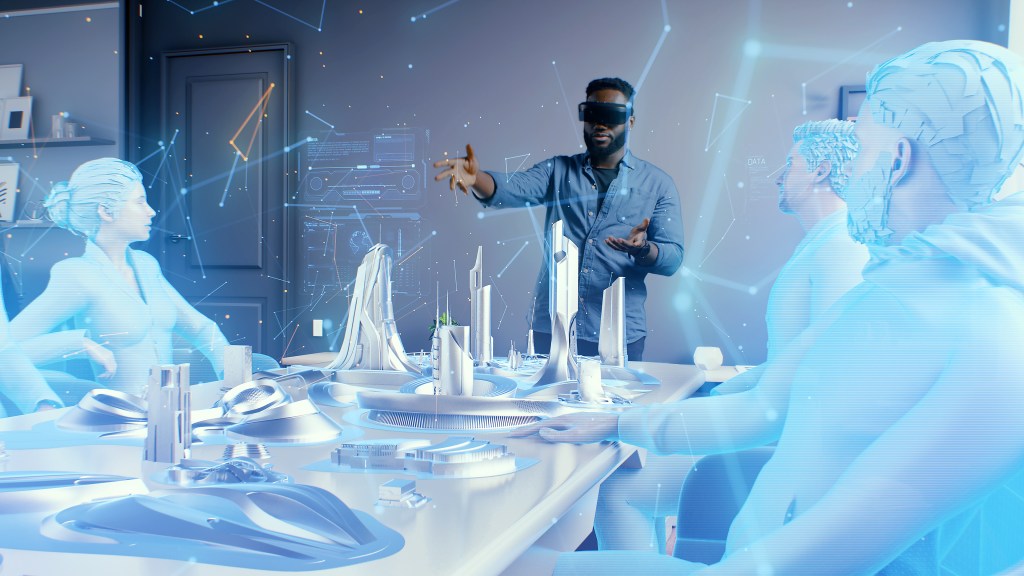
As hyperconnectivity turbocharges our digital interactions today, the question is what next. One of the most significant innovations that the imagination of science has inspired is that of the metaverse. This word has now come to mean a shared virtual environment created by the intersection of a physical reality that is enhanced virtually and a physically-persistent virtual space. However, when the word was coined in the 1992 sci-fi novel ‘Snow Crash’, it roughly described an online world that people explored using digital avatars. Although this idea of an embodied internet has been the talk of the tech town recently, it has been fascinating many of us for a while now.
As a gaming enthusiast, a discussion that I witnessed at the Gartner Symposium about a decade ago has stayed with me all this time. The virtual reality, and aptly named game ‘Second Life’, often referred to as the first metaverse, was examined in the symposium. Released as early as 2003, many pathbreaking elements of the game have helped us conceptualize the metaverse better. The game had no end goal; like social media, it was built around social interactions in a three-dimensional world, which also had its own economy. Similar to a plethora of other innovations, the supporting technologies for gaming and the metaverse have a lot in common, making the gaming industry one of the biggest drivers of this new universe. Developers, such as that of the first-person combat game ‘Unreal’, have successfully built and monetised virtual worlds.
However, gaming alone isn’t driving the evolution of the metaverse. Its implications are multifold in the manufacturing setting. Businesses are saving millions by adopting digital-first models for industrial process monitoring and troubleshooting. Metaverse tech has enabled digital twins – simulated versions of real-world objects that update based on spatio-temporal data. For example, in the automotive industry, simulated crash tests are saving manufacturers both money and time. Similarly, at ABB, we have the RobotStudio, which is open for use through a cloud-based subscription. The RobotStudio suite allows users to build robots in a virtual environment that will accurately replicate the functioning and movement of a physical installation, thus increasing productivity and enabling flexibility in production.
Although the metaverse is creating waves in Silicon Valley, it works wonders in a localised environment. Businesses are providing unique customer experiences using related tech. There is much to do at all levels of the stack before we have a sophisticated globalised virtual universe. But in an age where a social media giant rechristened itself to match the revolution, we know everyone’s focus is on creating this new universe. What else could we do entirely in a virtual environment in the near future?
 Marco's thoughts