-
The Sustainability Imperative (and thoughts on IT getting greener in 2026)

As we moved into the New Year a couple of weeks ago, I renewed my resolve to contribute to the global effort on environmental sustainability. The operative word here being “renew” – for the past decade or more, being conscious of my own carbon footprint has been a major area of focus. As has been the desire to positively influence this metric in the IS organizations I manage.
Now, more than ever, working in a way that is good for the environment is making a shift to being a core business priority rather than just a standalone initiative, with industries as a whole taking big steps towards turning sustainable. This is the larger picture and I believe we, as individuals, can equally do a lot more to contribute to this pressing need of the human race.
First and foremost, we can reduce electronic waste significantly through our actions and look more consciously towards our personal energy consumption. For example, producing the average desktop computer leads to consumption of an estimated 400 gallons of water (in the case of laptops, this jumps to 1100 gallons!). And, while we as individuals can’t necessarily influence production factors to bring these astounding statistics down, we can make a difference through the choices we make.
One of the ways to do this is to focus on DIY gadgets. For a long time now, I have chosen to assemble my own devices where I can. A self-assembled device feels like a piece of art, and the feeling of accomplishment when it’s up and functions smoothly is the same feeling that an artist would get when they look at a completed painting. And the satisfaction is manifold – because it isn’t just derived from the success of completion. But now, it goes way beyond that – what started off as a hobby to satisfy my creative urges on technology is now proving to be a great way to contribute to sustainability as well. By reuse of components, self-built devices help significantly reduce e-waste contribution to landfills. Done right, the DIY gadget can also be made inherently easier to upgrade, enhancing its shelf life.
The other aspect is choice of products. A short while ago, I’d written about how some makes of fountain pens and watches are made timeless, because they’re engineered to last. The time and craftsmanship that is put into each of them resists the logic of disposability. We can look at that as an act of sustainability that’s driven by passion, and to a certain extent, an emotional connection as well. The longer the life of a gadget, the lesser its disposability.
Another idea is what I call ‘social recycling’. In this age of fast fashion and constantly upgraded tech, the question of devices going obsolete is rampant. But what one individual finds outdated may work very well, functionally, for another. Examples of this include mobile phones being recirculated within families or friends at a time when one person chooses to make an upgrade. It’s the same logic as clothes being handed down from one member to the other. We are indeed at a time where the label of being “pre-loved” is as relevant to clothing as it is to technology!
But that needn’t always be looked down upon. It all ties up as being more environment-friendly options. The whole concept of the Cloud is the prime choice for sustainability. No longer do we have installation CDs for every software purchased. If you remember what a study desk looked like with a computer back in the 80s, you can clearly see the difference between then and now. From a bulky CPU and multiple components and CDs, DVDs stacked around the chunky computer, to a sleek laptop empowered with cloud storage, we’ve come a long way in terms of cutting down electronic waste.
Initiatives such as AI will eventually contribute to the sustainability initiative too. While it is currently, given its nascency, a resource-intensive technology, I have no doubt that innovations will rapidly lead to sustainable AI and that organizations globally will work towards reducing the carbon footprint of AI.
In short, sustainability doesn’t start or end with just one device. One can continue the cycle by donating and recycling parts and devices to lengthen their lifespan before they contribute to the landfills. And that’s what makes sustainability a choice – one that can be made repeatedly. Like Paul Polman says, “Looking at the world through a sustainability lens not only helps us ‘future-proof’ our supply chain, it also fuels innovation and brand growth.”
-
Engineered for eternity

I’ve often asked myself why I have such a deep passion for mechanical watches and fountain pens. Is it just a question of status?
The answer is no.
I like them because they are, in their own way, eternal. Unlike many of the objects we use everyday, they don’t become obsolete. A watchmaker can repair a mechanical watch an infinite number of times. A pen can be restored, refilled, polished, and passed on. It is a piece of heritage that lives on- from one generation to the next. It is a true triumph of engineering.
If you take a look at slogans used by watch manufacturers over the years, they echo the same sentiment- one of immortality. You must recollect “As long as there are men.” Or even, the one that talks of never actually owning a watch, but merely looking after it for the next generation. These ideas resonate deeply with me.
We, as humans, are not eternal. But we long for certain objects – those that bring us joy, meaning, or identity – to stay with us until the very end of our days.
For me, the fact that I can always repair a mechanical watch or a fountain pen provides a unique sense of reassurance. It reminds me that while everything else moves at the speed of digital, some things remain timeless. And that engineering can really make it last.
And maybe that’s why these objects bring not just functionality, but joy. They are living proof that time and craftsmanship can resist the logic of disposability. Passion is at the very core of these creations, which is also why a new version doesn’t release every few months. It is built to last.
Isn’t it fascinating how our brain works? Is it that we attach emotions, reassurance, and even hope to objects that outlast us? Maybe it is our mortality craving to be outlived by something the world will remember us by. A true test of skill- and a commitment to innovation. After all, the best technologies don’t get replaced. They get repaired, refined, and reimagined.
-
The Evolution of Human-Machine Interaction
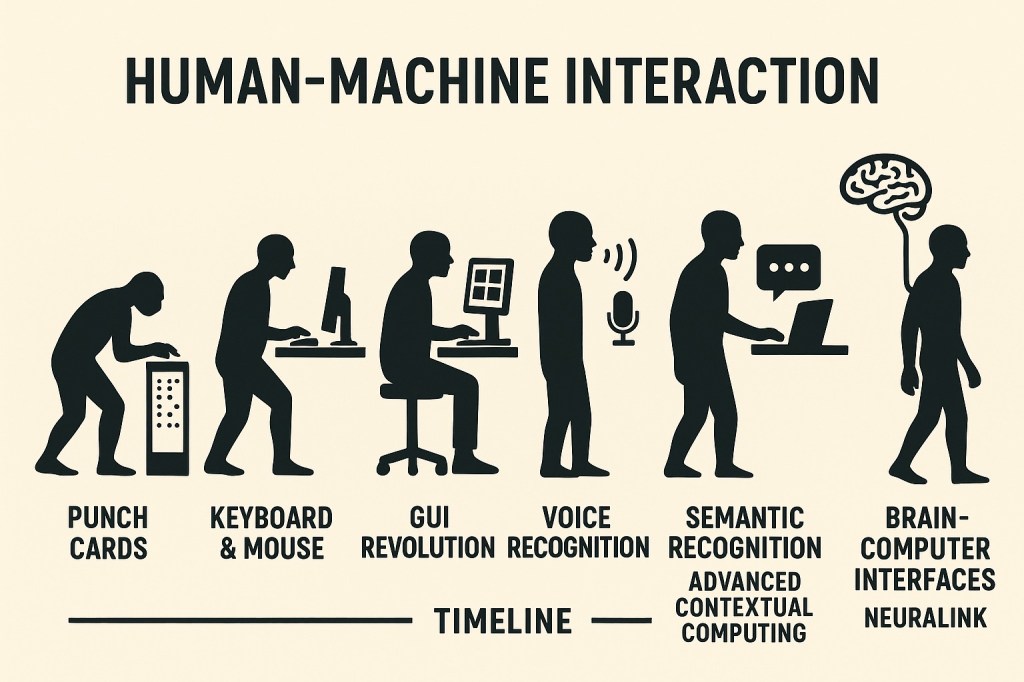
I really like the image that supports this blog, showing the progression of Human-Machine Interaction using the visual analogy of human evolution. This isn’t meant to be an immodest boast. It cannot be. This image isn’t my achievement. That laurel belongs to Generative AI, and it took all of 30 seconds to create it. Today, most creative expressions require just a strong foundational thought and the right prompts – a far cry from three decades ago when MS Paint, which intricately filled in individual pixels, or even as recently as five years ago where talented and trained graphic designers worked with specialist graphics editor software to create images.
My point is that technology has gotten so smart that it takes a few human inputs, stated in natural language, for the machine to understand exactly what you want and deliver an accurate representation of it, whether in words, pictures or even complex software algorithms. The interesting part of this is the inversely proportional relationship between the smartness of a machine and the amount of human effort required to get output from it. Modern aircrafts run on autopilot, whereas it took a human managing a bewilderingly intricate set of wires and levers to fly the original aircrafts like the Kitty Hawk. The modern day rail’s locomotive pilot presses buttons to control trains, whereas James Watt’s steam engine required them to continuously break their backs feeding coal into the engines and work in high temperatures.
I remember once hearing an interesting definition of a “machine” as something that is designed to reduce human effort. The relationship between a human and a machine is therefore one of input provision and resultant action respectively. This is where the inversely proportional relationship between the two (as I have mentioned above) intrigues me. The evolution of the machine, in this particular context, is comparable to how every human being evolves. As babies, we require a lot of input to get even the simplest output, whether in speech or in action. As we grow, our reactions to stimuli start getting increasingly sophisticated and faster and it takes lesser input to result in actions from us. Machines have evolved in a very similar fashion over time.
In computing, we have come a long way from the early days of human input through simple devices such as punch cards and switches or even the keyboard and mouse,to the modern, sophisticated methods such as voice-to-text of today. The finger has replaced the keyboard or mouse in several modern machines such as smartphones. The Graphic User Interface concept has become ultra-smart too and the need for these traditional input systems has reduced dramatically in modern GUIs.
What the mouse did for GUI navigation through Douglas Engelbart’s invention of it in the 1960s, with intuitive interactions such as hypertext linking, document editing and contextual help, conversational systems like Alexa and Google Assistant are doing today for touchscreens and voice interfaces.
Modern human-machine interaction is replete with accessibility, context awareness and personalization. It is this transformation in input systems which has paved the way for semantic recognition and advanced contextual computing. In more recent times, this is where AI has been leveraged to interpret what the user wants – beyond just simple commands. The move into the machine working on the intent of what the human wants is already here, with advanced natural language processing, and multimodal memory retrieval using text, voice, and visual cues. With the help of AI-driven contextual search and memory recall, we are moving towards a precision-first age of user engagement.
If we are already here, what’s next?
Think Black Mirror, but in a more positive way. The near future is all about brain-computer interfaces. Neuralink and similar efforts now represent the frontier of direct neural interaction – where thoughts can become machine commands, and unlock new forms of accessibility and augmentation. There are prototypes that feature high-density brain implants like the N1 sensor that control devices directly from neural signals. Think it, have it. And this is the future of seamless, intuitive and context-rich human and computer interaction.
From humans having to learn the language of the machine, to machines now learning the language of humans, we have made tremendous advancements in technology. And to think that all it takes to generate something is just a thought – no machine language, no codes.
And if the future is already here, what lies beyond?
-
Why Robotics Needs to Be Designed for Uncertainty

When we mention “robotics” today, let’s not immediately picture those complex images that you’d find on a stock photos website. Instead, I’d like you to take into consideration a device that you’re likely to have at home – the genius that is the little robotic vacuum cleaner. That little disc-shaped wizard glides across your floor on its own, doing its chores without a complaint in the world. It has evolved tremendously from its inception in 1996, and from bumping into obstacles all along its path to learn its route and struggling to climb over mildly uneven surfaces, robot vacuums have come a long way. They now understand maps, obstacles and blocks, and work around them independently without one having to pick them up and place them back like an unstable toddler that’s just learning to walk.
All this is mainly because robots nowadays are equipped with analytical models that need to plan for uncertainty. They have the ability to think of countless scenarios and work out how to overcome them. When it comes to preparing for conceivable scenarios, it’s impossible to be fully prepared. But empowering these robots with an understanding of what is important, and how to prioritize helps them learn and make decisions as they go.
And this is what designing for uncertainty is all about.
At ABB, we have Autonomous Mobile Robots (AMRs) which are designed to move and navigate independently in a given space using sensors and AI. These transport robots move loads autonomously in various industries – from automotive to logistics to consumer goods and other industrial processes. Earlier, they would follow a path they’d been taught to go on, and any reconfiguration of the path meant a reconfiguration of the robot as well. But it’s been learned over the years that change is inevitable, and in today’s tech world, uncertainty is built into the robot, giving it a decision making power.
What is uncertainty? It basically can be anything from an internal or external source that can break the fixed pattern of what the robot has learned. From changes in its usual environment to unplanned events, uncertainty is anything that causes the robot to evaluate factors that have come in its usual set pattern of decision making. It learns, evaluates its solution, and refines its abilities through this trial and error system. Remember our BASIC computer commands of IF, THEN, ELSE? It’s almost the same, but accentuated by the advances in technology like AI and Visual Slam.
Visual SLAM is a navigation technology that combines AI and 3D vision using off-the-shelf cameras. It allows AMRs to make intelligent decisions based on their surroundings, providing higher accuracy and robustness even in challenging environments. It can help differentiate between fixed navigation references and moving objects and people that aren’t permanently a part of the map. This adds a whole new dimension of flexibility to tackle how uncertain situations can be worked with.
This is the era of resilience in tech – where robots aren’t just about precision, but also adaptability. The more human they become, so does their power to make decisions and find a way around a situation that they hadn’t been programmed for, increase. And I’m not just talking about AMRs and robot vacuums, but everything from self-driving cars to educational, service and medical robots. Planning for uncertainty is surely less straightforward, but an essential step to make the robots of the future more robust, efficient and imaginative.
-
Momentum Is a Design Choice
Momentum is a critical, yet often overlooked aspect of program management. In my many years of designing and implementing complex, multi-stakeholder programs, this has been an important learning – that momentum is a major make-or-break factor. This is a result of the human psyche and a very innate bias towards organization and pigeonholing. Why is it that multitasking is something that everyone practices but few are actually good or effective at? It is again a result of this need for organization.
Distraction is a source of chaos. A killer of human focus. Chaos though is also a reality of most projects, unfortunately. Even the best conceptualized projects and programs face the plan-reality dissonance. Not everything goes as per plan – sometimes the factors affecting a program result in the need for minor tweaks and in other cases, major change of direction. However, it is inevitable that most programs roll out with the need for change and adaptation as they progress.
Maintaining momentum is a key success enabler in this context. It is common knowledge that most programs start with an immense amount of enthusiasm and eagerness, which fades over time. This is a psychological occurrence too – what seems novel and exciting at the start, progressively moves to becoming mundane. This impacts program momentum.
A glossary of physics terms will tell you that “momentum” is defined as “the quantity of motion of a moving body, measured as a product of its mass and velocity”. Or “the impetus gained by a moving object”. While we of course extrapolate this definition to the context of project and program management to imply that a project is moving along at a certain pace (predefined or otherwise), I do have an additional definition here. To me, momentum is also about keeping the focus of project teams alive, particularly when it comes to quality and innovation – the softer side of success in program rollouts.
This momentum isn’t accidental. It doesn’t happen on its own. It has to be built through deliberate rhythm, repeatability and realistic systems; and is something the leadership of the program must build into the system of program implementation. Momentum Maintenance should be an important line item as program managers work through designing implementation plans. It’s like choreography – planning it all out such that periods of high activity and low are planned to keep the traction going and introducing enough forums to ensure program teams stay motivated and focused.
Momentum, in that context, is something you build into the system. It looks at rhythm, repeatability, and steady frameworks that carry progress even on difficult days. It will show how designing for momentum means setting up systems that don’t rely on constant motivation but still move things forward. The idea is that the best momentum is engineered, not improvised. This is where the concepts of design thinking, especially the empathy for, and the foundation of human behaviour, are most relevant. Applying a structured process to this softer side of program rollouts is a critical element of program management – one that can make a major difference in achieving the optimal targeted result.
“You do not rise to the level of your goals. You fall to the level of your systems.”
– James Clear
-
The rise of AI agents and their increasing value in a changing enterprise context

That Artificial Intelligence has been a major game changer is a self-evident truth. After all, it has inspired a whole new industrial revolution of its own. The fourth industrial revolution (or Industry 4.0) has been built on the back of cutting-edge technologies, a list in which AI finds a major mention. So, in terms of transformative impact, AI is no less than what the steam engine was for its time or what the rise of computing represented in the 1960s.
We are increasingly seeing diverse applications of AI, and its widespread proliferation in almost every aspect of our lives. To the extent that we don’t even include smartphones without an AI capability of some sort in our purchase consideration set now. Every single major technology corporation is offering embedded AI for various business and personal applications. It is almost ubiquitous as a concept and its real-world application today.
However, to date, AI implementations in the enterprise have been largely limited to micro-impact. These implementations have mainly been in the form of chatbots or personal productivity tools. These are useful but, in my opinion, don’t do justice to the power and potential of this game-changing innovation. AI tools, still in the infancy of their application in organizational contexts, are yet to deliver material business impact at scale. Today, they assist individuals but don’t yet transform how work gets done.
All of this is at the cusp of changing. And driving this change will be the rise of AI agents, digital “colleagues” that can perceive, decide, and act autonomously. Unlike chatbots, agents are goal-driven, collaborative, and capable of executing tasks end-to-end, across systems and workflows. The introduction of AI agents is poised to significantly alter a paradigm that has been in play for over 30 years now: that we have been customizing our enterprise applications to improve efficiency. i.e. do more with fewer people.
With AI agents, this concept of reducing manpower to improve efficiency flies out of the window. To enhance efficiency, we can now have more workers, potentially an unlimited number, except that these will be digital coworkers. As this change comes into play, we will need to redefine our understanding and typical methods to calculate “efficiency”.
Today’s formula for this calculation is: Efficiency = Revenues / Human FTEs.
As we introduce AI agents into the mix, the formula changes to: Efficiency = Revenues / (FTE + aFTE) where aFTE = AI Full-Time Equivalent.
This will not be an easy change. It will have its complexity because the transition will not be just about introducing these agents. It will also be about making enterprise applications agent-friendly. Enterprise applications across practices and functions will need to become reliable and autonomous, beyond just being configurable, as they currently are. And this will be a multifaceted process involving technology migration, change management and widespread user acceptance.
This isn’t going to be an overnight transformation, but it’s coming fast. And companies that learn to deploy and manage AI agents at scale will unlock a new era of productivity.
-
Technology Can Connect Us — If We Use It Right

We’re living in a time when technology has made communication faster, easier, and more accessible than ever before. We can message, call, ping, tag, or sync in seconds. And yet, in most organizations, we still hear the same things: “I didn’t know,” “I missed that update,” or “We’re not aligned.”
In my experience, the issue is rarely the absence of information. It’s that communication is happening—just not landing.
Every generation seems nostalgic for the tool that came before. Email felt too slow, until instant messaging flooded our day. Video calls closed the distance but made it harder to focus. We’ve added formats, but not always clarity.
Over the years, I’ve found that connection doesn’t come from the channel. It comes from how you use it. These are three principles I’ve relied on to keep communication meaningful across teams:
1. Adjust the style
Know who you’re speaking to—and how they process information. If you use the right tool with the wrong tone or structure, your message can feel off, no matter how relevant it is. Great communication starts with knowing your audience.
2. Keep it brief
Remember when Mark Twain said, ““I didn’t have time to write a short letter, so I wrote a long one instead.” That’s because clarity takes effort. When information is dense, fragmented, or over explained, it gets ignored. Focus on what matters most—and say it with intention. Brevity builds trust.
3. Choose the right channel
Not everything needs a meeting. Not everything works in a slide deck. Sometimes an email is better left unsent. Misalignment often isn’t about what was said, but how and where it was delivered. Use the channel that respects the message—and the person receiving it.
These ideas aren’t complicated. But they’ve helped me communicate more clearly—especially across complex teams, fast-moving projects, and digital-first environments.
Technology gives us reach. But connection? That still depends on how well we listen, shape, and deliver what we say.
-
The Rhythm That Keeps Goals In Focus
Setting a clear goal for any project is always a great way to start it. The trick, I have learnt through my many years of managing complex projects, is to ensure that the momentum stays high between that first spark, through making real progress, to the final achievement of the goal.
One big risk in every project is that gap between intention and execution. It all starts with excitement: a burst of momentum, maybe even a brand-new app or productivity system. But slowly, things shift. Priorities pile up. Energy dips. Focus begins to blur.
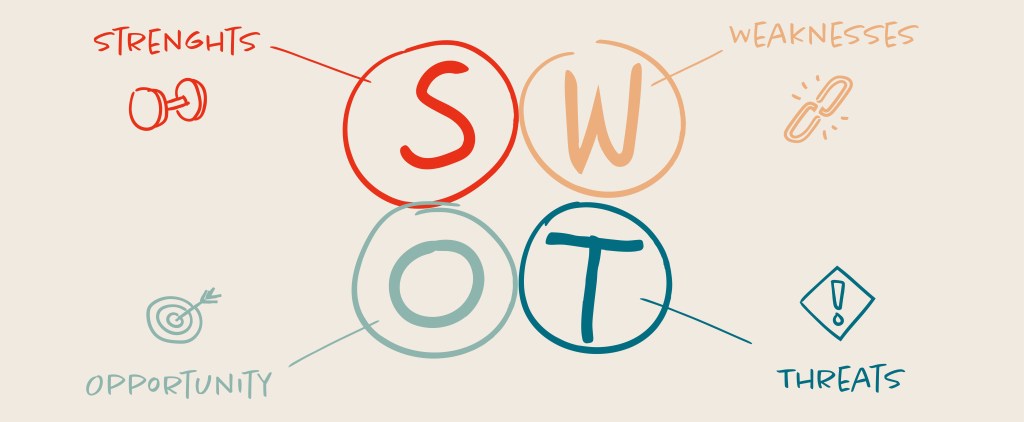
Over the years, I have found a simple method to help build the rhythm as I move from intent to action—not perfectly, but consistently. It’s simple, but it works. And more than that, it’s something I return to whenever the path forward feels cluttered. And this is the concept of SWOT analysis.
It begins, as most things do, with the goal itself. Whether it’s professional or personal, I try to define not just where I want to go, but what success looks like when I get there. The sharper that picture, the more naturally momentum follows. This is the stage then that the SWOT analysis really starts to come in as a gamechanger. What strengths can I lean on? What weaknesses might hold me back? What opportunities could help me move faster? And what threats or risks do I need to account for? It’s a short exercise, but it brings clarity to where I stand and what I’m dealing with.
Off late, I have also started experimenting with generative AI to add more value to SWOT analysis. While the basic principles and foundational ethos remain unchanged, generative AI tools are helping with ideas that are often smart, structured, and surprisingly insightful, once the context is input. I am seeing responses from such tools uncover new angles and sharper sequences; even, identify blind spot I hadn’t considered—and often, that’s all it takes to move forward with more clarity.
After this definition of the context of SWOT, comes the step of visualizing it in an impactful manner. I usually use a simple visual—a Gantt-style layout with rough timelines and key milestones. It helps me see the shape of progress, and it gives me a reference point I can return to each morning to ask: what’s the one thing I need to move today?
And this is where it counts: the follow-through. The daily return to the plan. Not in bursts, not in sprints—but in steady, consistent steps. The real magic often shows up not in the leaps, but in the discipline to keep going—especially on the days when energy is low or the goal feels distant. Those are the days the system earns its keep.
I believe that the simplicity of my method for rhythm building is what makes it powerful. It gives structure without rigidity, and it helps me move even when things around me are shifting. And with GenAI now being part of that rhythm, it has become even easier to start strong—and keep going. Not by outsourcing the hard parts, but by adding a layer of clarity and speed when it’s needed most.
There it is then – my simple formula to go the distance by ensuring that reflection, structure, and momentum all move in the same direction.
-
Majorana 1: A Quantum Leap Rooted in a Century-Old Mystery

This week, Microsoft unveiled something that could change the landscape of computing: Majorana 1, a quantum CPU built to solve one of quantum computing’s biggest challenges—stability.
Unlike traditional quantum chips, Majorana 1 is designed to use Majorana fermions—exotic particles that could make qubits more error-resistant and scalable. It’s a bold step, one that moves quantum technology closer to real-world applications.
But there’s something fascinating about this name—Majorana.
Because long before quantum computing was even a concept, there was a physicist whose ideas laid the foundation for this breakthrough. A physicist who, in 1938, vanished without a trace.
Ettore Majorana: The Scientist Who Disappeared
It’s not often that a scientist becomes a legend. But Ettore Majorana wasn’t just any scientist.
Born in 1906, he was one of the greatest minds of his time. Even Enrico Fermi—his mentor and one of the key figures in nuclear physics—compared him to Newton and Galileo. Majorana had an instinct for physics that seemed almost otherworldly. In 1937, he predicted the existence of particles that are their own antiparticles, now called Majorana fermions. It was a radical idea, one that would take decades to prove. But then, just a year later, Majorana was gone.
In March 1938, a ferry departed from Palermo to Naples. Among the passengers was Ettore Majorana. But when the ship docked, Majorana was nowhere to be found. He had vanished without a trace.
Some say he chose exile. Others believe he was silenced for knowing too much. A few even claim he lived under a new identity, watching the world change from the shadows.
What we do know is that his ideas never disappeared. In fact, almost a century later, Majorana’s theories are shaping the future of modern quantum computing.
From Theory to Reality: The Majorana 1 Quantum Chip
Quantum computers hold enormous potential, but their biggest flaw is instability—qubits are fragile and easily disturbed, making calculations unreliable. Microsoft’s Majorana 1 chip is an attempt to fix this issue at the fundamental level, using Majorana fermions to create topological qubits that are far more stable and resistant to errors.
If successful, this could be the breakthrough that finally makes quantum computing scalable and practical. It’s the kind of shift that could reshape industries, from materials science and cryptography to artificial intelligence.
And at the heart of it all? An idea first written down in 1937.
A Legacy That Refuses to Vanish
Majorana’s ideas were ahead of their time—so much so that only now are we beginning to harness their full potential. His work on exotic particles has gone from theory to reality, shaping the foundation of next-generation computing.
It’s strange to think about. A man who vanished nearly a century ago now has his name etched into one of the most ambitious quantum projects in history.
His story, like his particles, exist in a strange superposition—caught between genius and mystery, waiting for the world to finally catch up.
-
Technologies for a cleaner planet
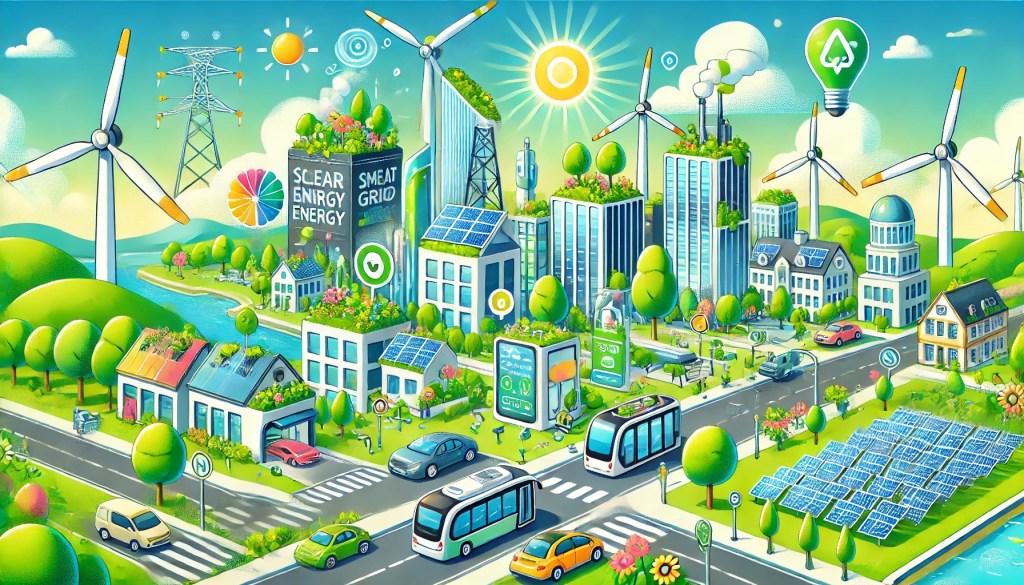
It is obvious that climate change is a major challenge that humanity is facing today. It isn’t some distant possibility anymore – it is a real, major, imminent global threat. We are already seeing the impact of climate change, from record-breaking wildfires to extreme weather events. And I believe that technological advancements have some answers to help us control this very worrying trend and contribute to a brighter tomorrow for generations to come. With the right innovations, we can create real solutions and innovations to cut emissions, improve efficiency as a human race and build a more sustainable future.
Technology and the power grid
Fossil fuels being used to power up our world is a major contributor to climate change. With more efficient power grids and enabling faster adoption of renewable energy, technology is helping us get smarter about the way we generate and transmit power. As energy systems evolve, technology innovation is helping create more resilient energy networks, with smart grids that allow better integration of renewable sources such as solar and wind.
This makes the power supply more stable and, of course, helps dramatically reduce dependence on fossil fuels. Add to this the impact of AI-driven energy management, with AI taking energy efficiency to a new level. Intelligent systems can monitor and optimize energy use in buildings, cities and industrial sites, minimizing waste and ensuring resources are used where they’re needed most. Energy resilience matters. Microgrids, powered by local renewable energy, ensure communities can stay powered even if the main grid fails. These decentralized energy systems are especially valuable in disaster-prone or remote areas.
Significant strides are being made in clean energy sources, one example being hydrogen as a clean energy carrier. Green hydrogen is emerging as a powerful clean energy source. It can store and transport energy without the emissions of traditional fuels, making it a game-changer for industries like shipping and heavy manufacturing.
Creating more intelligent industries
Industries are the bedrock of human economic activity and, as industrial output increases to meet the demands of a fast-growing world population, factories are contributing to a significant chunk of global emissions. Industrial automation is changing that by ensuring that industries get increasingly ecologically efficient without the need to slow down or pull back.
Smarter, more efficient systems can optimize production lines, reduce waste, and cut down on unnecessary energy use. The impact is massive when scaled across industries. Having said that, certain industries like steel and cement, will always produce emissions. That’s where Carbon Capture and Storage (CCS) comes in—capturing CO2 at the source and storing it underground instead of releasing it into the atmosphere. It’s not a silver bullet, but it’s a crucial tool for high-emission industries. This is all being augmented by some very intelligent systems being developed to help industries contribute to the world’s target on green initiatives. One transformative example here is digital twins, now being used extensively by industries to simulate and optimize processes, reducing inefficiencies and unnecessary emissions before anything is built or changed in the real world.
Altering the way we live, work and play – to create the impact of scale
Almost every human activity is today being influenced by the emergence of tools and technologies that allow each of us to contribute to climate change control. For example, electrification technologies are having a major impact on transportation, another big contributors to greenhouse gas emissions. Electric vehicles (EVs), combined with widespread charging infrastructure, are making the shift away from fossil fuels possible. The transition is picking up pace, and as battery tech improves, EVs will only become more accessible.
EVs are not just limited to personal vehicles but to mass public transport as well. Add to this, innovations that are being explored for aircraft engines to adapt to biofuels and other sustainable fuels and the impact on transportation is a major one. Our buildings are getting smarter and infrastructure far more sustainable. IoT-enabled systems can adjust heating, lighting, and energy use in real time, cutting waste without sacrificing comfort. Meanwhile, sustainable materials in construction are lowering the long-term environmental footprint of new developments.
By doing our bit, we are all contributing to the emergence of the circular economy and resource optimization. Waste is a problem, but technology is turning it into an opportunity. Digital solutions help industries adopt circular economy principles—recycling materials, reusing components, and minimizing unnecessary consumption to reduce environmental impact.
Climate change is a complex issue, but technology is a key part of the solution. From smarter grids to AI-powered efficiency, these innovations aren’t just ideas—they’re already reshaping industries and cutting emissions. The road ahead won’t be easy, but with the right tools, we can build a more sustainable future.
-
Subscribe
Subscribed
Already have a WordPress.com account? Log in now.
 Marco's thoughts