-
Beyond the AI Hype: The Infrastructure Challenge
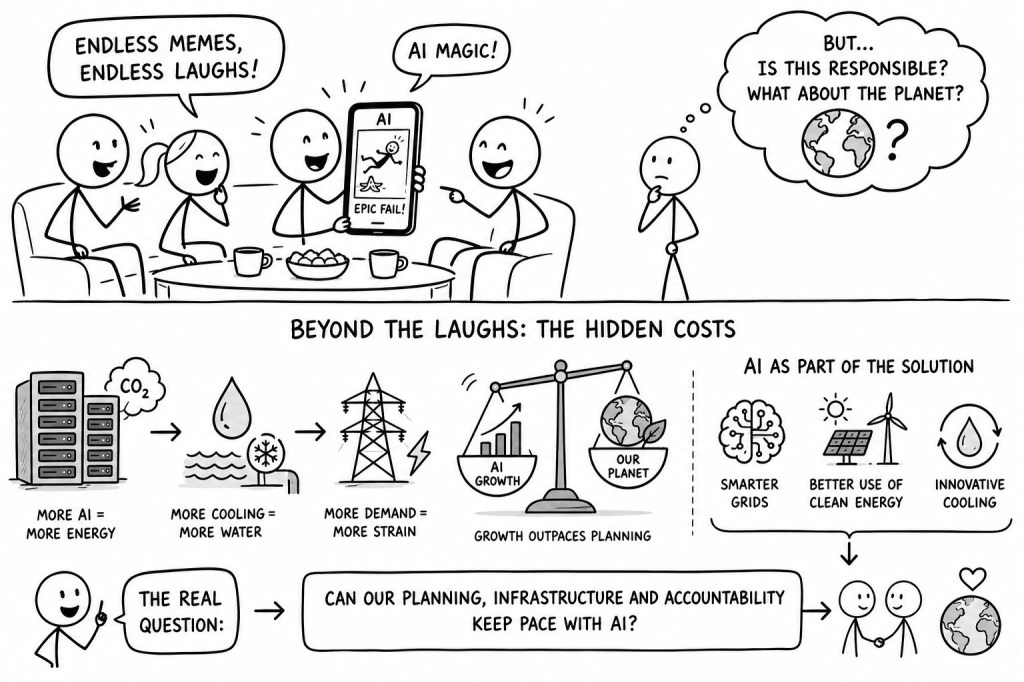
I often come across debates and discussions which try to frame “responsible use” for artificial intelligence. This debate centers around the emerging understanding of the ecological impact of AI. An example that illustrates this “responsible use” discussion is the casual use of Generative AI to generate memes or funny images that is of no benefit to us, except for a momentary laugh. Was it worth the resources used to create something so transient?
When people talk about AI, the recurring themes tend to center on three things- its potential (what the technology can produce), economic impact (what it might displace) and, to a lesser extent, ecology (carbon footprint of its working). Image generation tools spark debates about creativity and jobs. Chatbots spark debates about the future of work. What also gets discussed, albeit more rarely, is the physical infrastructure that makes all of it possible.
These are, of course, my personal observations and based purely on my experience of the conversations I participate in. It is altogether possible that the infrastructure, which has had to scale to unprecedented levels to keep pace with AI functionalities and adoption, is being developed extensively in relevant circles. The infrastructure story, which I believe to be most consequential, is what I’d like to explore here – and do so on the back of data points that are available.
The demand v/s the planning
Starting with the obvious one – energy use. Energy use by data centers, which form the backbone of AI processing, currently accounts for around 1.5% to 2.1% of global electricity use, and has been growing by approximately 17% annually, according to the International Telecommunication Union. AI requires exponentially more power to train and run than preceding technologies. As of 2026, AI-optimized servers account for 31% of total data center power consumption, and this is forecast to surpass conventional server power use by 2027, according to a Gartner study.[1]
This energy debate reminds me of another one from a few years ago – that of electric vehicles. But, the context is different. Energy demand by AI is different from the ones by EVs, which largely displaces one form of energy consumption (fuel) with another (grid electricity). One might argue that this improves overall efficiency in the process. Data centre growth, by contrast, is additive. It does not replace an existing category of consumption – in fact, it introduces a new and fast-growing one on top of it.
Before the rapid growth of AI in the last decade (or less), many early proponents of the technology made public commitments around carbon neutrality, carbon-negative targets, and renewable energy sourcing – some even setting goals to be carbon negative by a certain time. These commitments were built based on assumptions about how much computing infrastructure the companies would need. But, the pace of AI has outstripped all of them. Some companies that had made such promises have actually reported a rise in emissions attributable to them. A review of 200 leading digital companies found that indirect emissions across the sector rose roughly 150% between 2020 and 2023, driven largely by AI-related infrastructure growth. Though these companies have set emissions targets, those targets have not yet fully translated into actual reductions.
This is not about broken promises, but a legitimate strategic challenge. The landscape has changed, and so the target has become one that’s shifting. The fact that companies have not been able to stay on course for this target should not, in my opinion, be construed as lack of sincerity, but as a timeframe realignment. Should these companies compare scale with usage rather than dates on a calendar? This is one of the questions AI has brought up, which probably no other technology has encountered before.
All about water
Cooling is one of the more tangible costs of data centre operation, and freshwater remains the most common method. Water runs through pipes to absorb and remove heat generated by servers. Because of this, water use has become a major topic of discussion on the ecological impact of data centres.
I was intrigued when I learnt that golf courses use several times more water than data centres and a majority of this water seems to come from natural sources rather than treated, as per a study. Which begs the question – isn’t golf, like the meme example I used earlier for “responsible use”, an avoidable leisure activity whose physical benefits can be gained by other other sports which use lesser water? But, I digress – the example of golf courses emerges from the water use statistics and how it is viewed.
The data centers vs. golf courses water use example is based on gross numbers. The counter argument relates to data points applied in localized contexts – for instance, a single large data centre campus can draw more water from a specific local supply than several golf courses in the same region combined. When we look at AI infrastructure scaling at its current pace, it will surely overtake the water consumption of golf courses in the next few years.
The points I am making here are two-fold: a. single statistics deserve care before they’re used to draw conclusions and b. AI is very early in its evolution cycle to make an informed judgement about its ecological impact.
This is because the industry is working on solutions to optimize the use of natural resources, especially water . Closed-loop cooling systems, which re-circulate water within a sealed system rather than relying on evaporation, can reduce consumption significantly compared to traditional cooling. Some companies are piloting alternatives to freshwater entirely. One significant experiment in this context is use of filtered seawater/ salt water as a cooling source for certain facilities. The approach may be in its early stages, but it’s promising to know efforts are being made in this regard.
AI as part of the solution
When we speak of AI’s grid infrastructure, it is no longer only about additive strain. The same technology is being used as an advantage, by making grids more efficient. According to the International Energy Agency[2] , AI-driven grid management tools could help unlock up to 175 gigawatts of existing transmission capacity that would otherwise sit underused, reducing the need for entirely new infrastructure investment. AI systems are also being deployed for predictive maintenance, faster interconnection planning, and better integration of renewable sources like solar and wind, which depend on real-time adjustments to variable supply. So it’s interesting to note that the same demand growth that is straining grids today is also accelerating investment in the tools that are helping make the grids more capable of handling this same strain.
This plethora of innovations and experiments today make it challenging to draw a conclusive statement on the ecological impact of AI. The rapid evolution and pace of AI is something that even companies building this technology are still adapting to. Yes, this development has come with some additional load on energy and water consumption, but the same technology is also leading to unprecedented progress in making this infrastructure more efficient and sustainable.
The better question for us to ask isn’t whether AI’s environmental footprint is good or bad. It’s more about whether planning, reporting, and infrastructure design are keeping pace with the growth curve, and what it would take to make sure they do. As AI evolves and takes massive leaps every single day, we simply need more responsibility and accountability, every step of the way, to maintain the balance that we strive to achieve.
[1]https://www.gartner.com/en/newsroom/press-releases/2026-06-10-gartner-says-data-center-electricity-demand-to-grow-26-percent-in-2026
[2]https://www.iea.org/reports/energy-and-ai/ai-for-energy-optimisation-and-innovation
-
AI Enterprise Architecture Toolkit for CEOs and CFOs
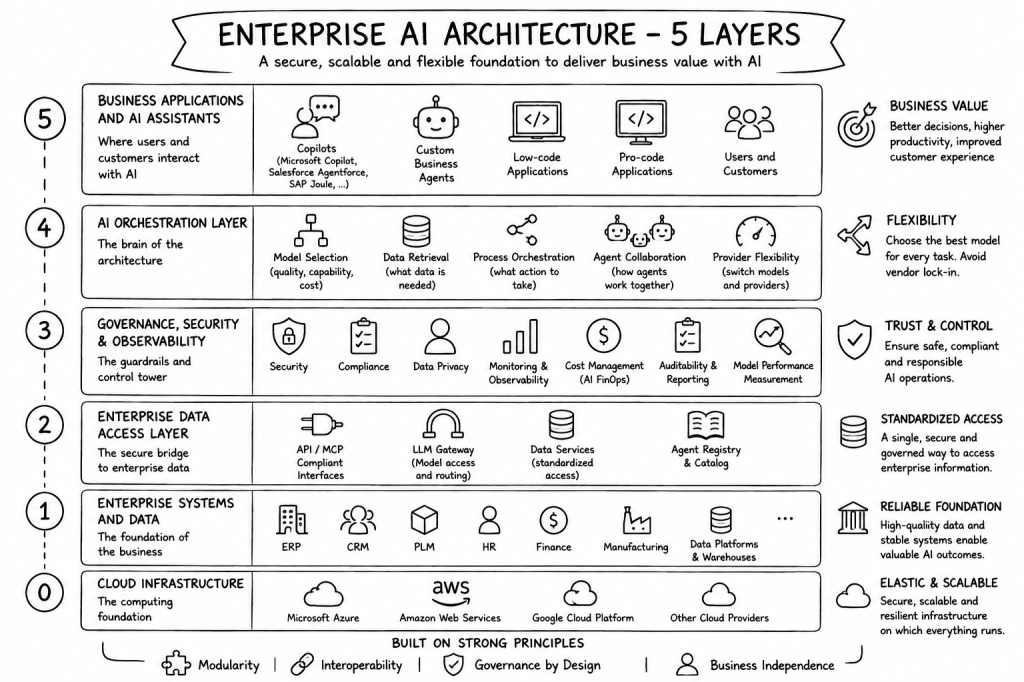
Artificial Intelligence is rapidly becoming part of every business discussion. Yet many executive conversations focus on AI tools, vendors, or use cases, while overlooking a more fundamental question:
What does an enterprise-grade AI architecture actually look like?
Just as ERP systems, cloud computing, and cybersecurity required specific architectural foundations, AI also requires a structured architecture to be scalable, secure, and cost-effective.
Four Architectural Principles
Regardless of technology choices, successful AI architectures follow four principles.
- Modularity: Components should be replaceable without redesigning the entire ecosystem.
- Interoperability: Different platforms, models, and agents must work together.
- Governance by Design: Security, compliance, and observability should be embedded from the beginning.
- Business Independence: Business processes should never depend on a specific AI provider.
Building Blcks of an AI Strategy
This article introduces the key building blocks everyone should understand when discussing AI strategy.
Layer 0 – Cloud Infrastructure
Every AI solution ultimately runs on computing infrastructure, whether in public cloud, private cloud, on-premise environments, or at the edge. Whether provided by Microsoft Azure, Amazon Web Services, Google Cloud Platform, or other providers, this layer delivers the computational power required to train and execute AI models.
The key consideration is not the technology itself but understanding that AI consumes significant computing resources and therefore has a direct economic impact.
Layer 1 – Enterprise Systems and Data
This layer contains the systems that run the company: ERP, CRM, PLM, HR systems, Manufacturing systems, Data platforms.
These systems contain the knowledge of the enterprise. A simple rule applies:
Without access to enterprise data, AI remains an intelligent assistant. With access to enterprise data, AI becomes a business capability.
Layer 2 – Enterprise Data Access Layer
One of the biggest mistakes organizations can make is connecting every AI solution directly to every application. Instead, leading companies introduce an abstraction layer between enterprise data and AI platforms.
This layer provides secure and governed access through APIs, emerging standards such as Model Context Protocol (MCP), and others standardized interfaces. Think of it as the “universal translator” between business systems and AI.
The strategic benefit is flexibility. Business systems remain stable while AI technologies continue to evolve.
Layer 3 – Governance, Security and Observability
This is often the least visible but most important layer. It includes:
- Security
- Compliance
- Data privacy
- Monitoring
- Auditability
- Cost management
- Performance measurement
If Layer 2 answers the question: “Can AI access our data?“
Layer 3 answers: “Should it?“
This layer establishes trust and control. Without it, AI adoption will eventually collide with regulatory, legal, or operational concerns.
Layer 4 – AI Orchestration
This is the brain of the architecture. Its role is to decide:
- Which AI model should be used
- Which enterprise data should be retrieved
- Which business process should be triggered
- How multiple AI agents collaborate
The orchestration layer coordinates models, agents, tools, and workflows to execute business tasks based on capability, performance, and cost. This prevents dependence on a single provider and allows continuous optimization.
Layer 5 – Business Applications and AI Assistants
This is the layer employees and customers actually see. Examples include:
- Microsoft Copilot
- Salesforce Agentforce
- SAP Joule
- Industry-specific AI assistants
- Custom-built AI agents
A common misconception is that these tools are the AI strategy. They are not. They are simply the user interface of a much broader architecture. The true enterprise value resides in the layers below.
Beyond Technology
Even the best architecture will fail without four complementary elements:
- Process reinvention
- Workforce upskilling
- Strong operating models
- Strategic ecosystem partnerships
Technology creates potential. People, processes, and governance convert that potential into business value.
A Final Thought
- Twenty years ago, every executive learned the basics of ERP.
- Ten years ago, every executive learned the basics of cloud computing.
- Today, understanding AI architecture is becoming equally important.
Not because CEOs and CFOs need to become technologists, but because the quality of their strategic decisions will increasingly depend on understanding the foundations on which enterprise AI is built.
-
From fax machines to AI agents – The Evolution of Work
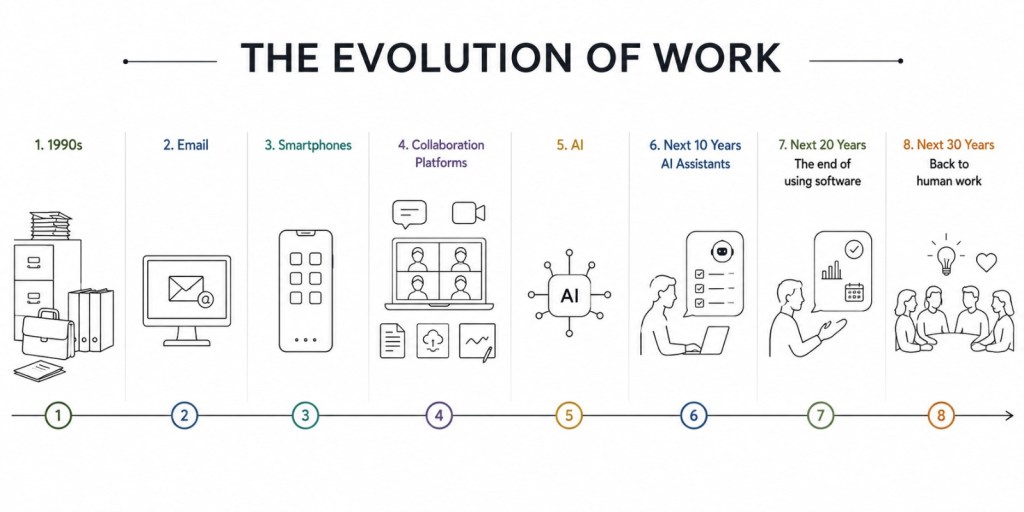
Thirty years ago, when I just started working, the office sounded very different. Printers were loud enough to qualify as industrial machinery. Modems sang strange robotic songs while we waited for them to connect to the internet. And if someone told you that they’d sent you a message, it most probably meant that it was a fax, a voice mail or a handwritten note on your desk. These were before the days of e-mail. Well, technically, it still existed, but to most people, it was closer to science fiction than productivity. Our “cloud” was a cabinet full of folders. And our version of the search option was to physically look for whatever you wanted. Sometimes, you even had to talk to people face-to-face! They were terrifying times indeed.
The era of physical work
In the 1990s, work had weight. Documents were printed. Presentations were carried in bags. Meetings required actual travel. And losing a notebook could create more panic than losing a smartphone today. It was a time when knowledge moved slowly and decisions took longer. But strangely, we were often less stressed. You could leave the office and become unreachable. Imagine that happening today! Disappearing for even two hours creates the same organizational reaction as a cyberattack!
Humanity’s first productivity trap
The arrival of the e-mail felt revolutionary. Suddenly communication became instant. No more waiting days for replies. No more fax paper jams. We lived under the delusion that technology would give us more free time.
But let’s not forget that humans also invented –
- Reply All
- Endless CC lists
- And the beautiful sentence: “Just checking if you saw my previous e-mail.”
E-mail increased productivity enormously, while simultaneously creating an entirely new category of work- that of managing e-mail itself. It is, some might say, an innovation worthy of admiration.
The escape of the office
Then, smartphones arrived. For the first time in history, work became portable. At the beginning, it felt empowering to answer e-mails from anywhere, access documents remotely and even join calls when travelling! But it wasn’t long until we realized something important.
We realized the office was no longer a place.
The office was following us. Vacations became remote working with a better view.
To infinity and beyond!
Collaboration was the next big thing. It was the coming of multiple chat platforms, video calls, shared documents, digital whiteboards, project management tools, and collaboration ecosystems.
The promise was simple. To work together more efficiently.
But the result? Meetings to prepare for other meetings. Chats discussing previous chats. And collaborative documents where nobody knows who changed what.
At some point, we have collectively accepted that spending eight hours per day discussing work has somehow become equivalent to doing work. A fascinating sociological evolution indeed!
And now… AI
We are now in the midst of another transformation. The magic two-letter word.
AI is not just another software tool. It’s the first technology that actively collaborates with us intellectually. It writes, summarizes, analyzes, generates code, creates presentations, translates and even challenges ideas.
For the first time, many people are not using software anymore. They are interacting with something that looks surprisingly close to a digital colleague.
And this changes everything.
The next 10 years: AI assistants everywhere
In 10 years, I suspect most professionals will have a personal AI assistant working continuously beside them. And no, I don’t mean a chatbot. We are likely to have a real operational companion that prepares meetings, negotiates schedules, helps draft decisions, monitors projects and anticipates risks. It might even politely tell us when our ideas are terrible!
The funny thing?
Young employees entering the workforce will probably look at us the same way we looked at people using fax machines.
“Wait… you manually created PowerPoint slides?”
Yes. And we survived.
The next 20 years: The end of using software
Twenty years from now, I believe many traditional applications will disappear. Instead of learning systems, menus, and interfaces, people will simply describe outcomes.
Imagine saying- “Prepare the quarterly business review, analyze the market, identify risks, create the presentation, and schedule a rehearsal with the leadership team.”
And the digital ecosystem simply executes. The concept of ‘software training’ may sound as old-fashioned as typing classes today.
The next 30 years: When work will become more human again
My prediction for the future is all about coming back, full circle. This may sound paradoxical, but I believe AI will eventually make work more human. Why so, you may ask. Simply because once machines handle repetitive cognitive tasks, uniquely human capabilities become more valuable. Just like the people on the internet are now complaining about “AI slop” for the overuse of what’s not ‘real’, we are probably going to place a lot more value on qualities like judgement, trust, creativity, leadership, empathy, ethics and vision. The future CIO, CEO, engineer, or entrepreneur may spend less time producing information and more time interpreting meaning.
Ironically, after decades of technology pushing us toward screens, AI may bring us back towards what humans do best- thinking, imagining and connecting with each other.
But one thing never changed…
Even after 30 years of technological revolutions, one thing remained surprisingly constant. People still complain about too many meetings.
There are some things even AI will never fix. Probably.
-
Sustainability in Robotics – it’s all about the orchestration
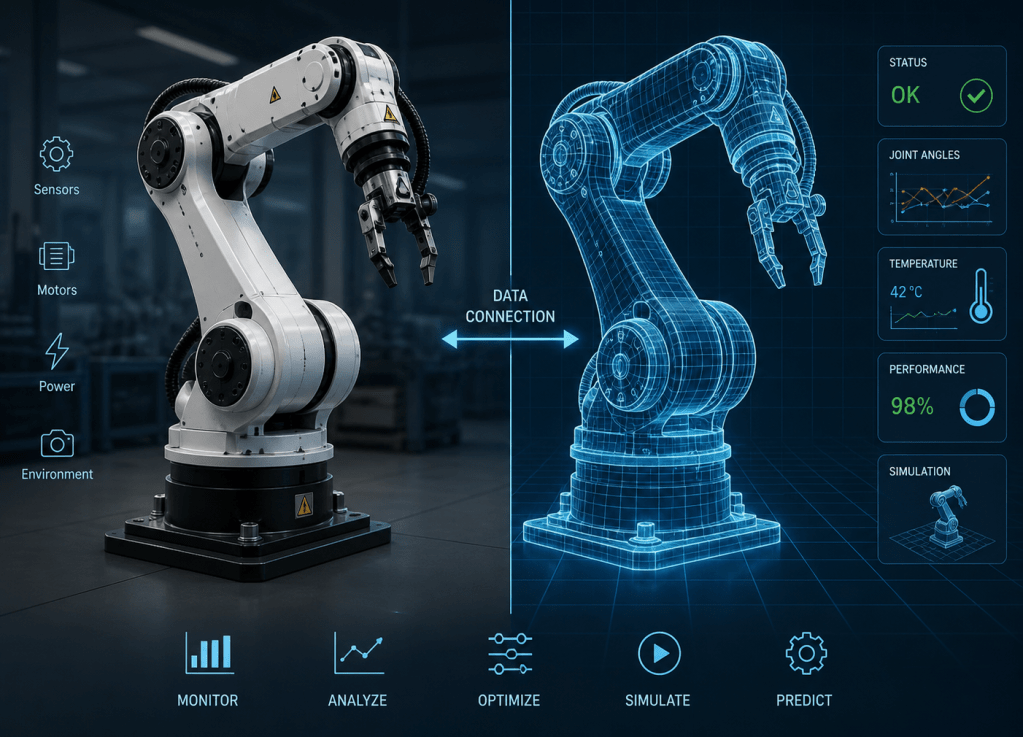
While environmental considerations have been a focus area for the scientific community for some time now, its formal acknowledgement as a topic of interest was a declaration on 22nd April 1970. Resulting in a date we still celebrate as World Earth Day. In its early years, environmental concerns centered around pressing topics of the time – primarily clean air and water. As the world has evolved, the topic of conservation against the backdrop of technology has gradually moved more towards sustainability.
Robots play an important part in the sustainability conversation. This has, however, rapidly moved away from the concept of building energy-efficient machines, in the recent past. Today, the emphasis on sustainability in robotics is about how information systems manage these machines—whether they do it continuously, intelligently, and at scale.
Efforts to make robots more efficient have been ongoing for years. But the breakthrough that we’re probably waiting for is based on when they are made smart enough to know when not to work. In short, it’s all about the ability of robots to make decisions, rather than the actual hardware of the machine itself. A robot is only as smart as its motor and materials and only as sustainable as its power consumption. Limitations inherent in robotic hardware imply that true sustainability will need to go two steps beyond this – into decision-making that determines when and how often a robot runs, and when it can limit itself. This is the true shift that now needs to be made – from engineering to orchestration.
Information systems need to move the focus more into how robots modify the way they function during low demand windows. Optimizing their energy usage would also mean powering down robots that are idle. Redistribution of workloads based on the output isn’t really something that engineering design can address, but a smart information system definitely can. However, this cannot happen in isolation – and this is where orchestration matters.
One of the easiest ways to make orchestration intelligent is to introduce digital twins. It is one of the more obvious methods to shift sustainability from reactive intent to preemptive design – where systems are optimized before resources are consumed. To explain it simply, it’s about creating a living, virtual model of the robot, its environment and the workflow, so that the system can simulate, predict and optimize operations before anything happens in the “real” world.
I was inspired, in this regard, by the concept of Virtual Singapore, a highly detailed 3D digital twin of Singapore in its entirety. This twin integrates data from buildings, transport systems, population and weather, Enabling the administration to manage heat during sharp weather conditions, and set rules for building design to make spaces cooler. It also tests energy efficiency during construction and allows a trial for the use of sustainable alternatives. Disaster management helps plan for emergencies, much before the city becomes vulnerable. This is a perfect example of how environmental impact is reduced on a large scale.
Hardware enables motion, orchestration governs behavior, and digital twins provide the intelligence layer that makes that governance sustainable. They help reduce idle time, cut unnecessary energy use, improve maintenance timing, and avoid waste from trial-and-error operations. That makes robotics less about building the “greenest machine” and more about running the whole robot ecosystem in the smartest possible way.
In sustainable robotics, the real leap does not lie in better machines, but in better coordination. It is all about the intelligence that decides how a hardware is used. Digital twins sit at the center of this shift. They connect the physical robot to a virtual system that manages energy, optimizes maintenance and continuously refines operations. In short, they turn a hardware problem into an orchestration problem, and orchestration into a sustainable strategy.
-
The Sustainability Imperative (and thoughts on IT getting greener in 2026)

As we moved into the New Year a couple of weeks ago, I renewed my resolve to contribute to the global effort on environmental sustainability. The operative word here being “renew” – for the past decade or more, being conscious of my own carbon footprint has been a major area of focus. As has been the desire to positively influence this metric in the IS organizations I manage.
Now, more than ever, working in a way that is good for the environment is making a shift to being a core business priority rather than just a standalone initiative, with industries as a whole taking big steps towards turning sustainable. This is the larger picture and I believe we, as individuals, can equally do a lot more to contribute to this pressing need of the human race.
First and foremost, we can reduce electronic waste significantly through our actions and look more consciously towards our personal energy consumption. For example, producing the average desktop computer leads to consumption of an estimated 400 gallons of water (in the case of laptops, this jumps to 1100 gallons!). And, while we as individuals can’t necessarily influence production factors to bring these astounding statistics down, we can make a difference through the choices we make.
One of the ways to do this is to focus on DIY gadgets. For a long time now, I have chosen to assemble my own devices where I can. A self-assembled device feels like a piece of art, and the feeling of accomplishment when it’s up and functions smoothly is the same feeling that an artist would get when they look at a completed painting. And the satisfaction is manifold – because it isn’t just derived from the success of completion. But now, it goes way beyond that – what started off as a hobby to satisfy my creative urges on technology is now proving to be a great way to contribute to sustainability as well. By reuse of components, self-built devices help significantly reduce e-waste contribution to landfills. Done right, the DIY gadget can also be made inherently easier to upgrade, enhancing its shelf life.
The other aspect is choice of products. A short while ago, I’d written about how some makes of fountain pens and watches are made timeless, because they’re engineered to last. The time and craftsmanship that is put into each of them resists the logic of disposability. We can look at that as an act of sustainability that’s driven by passion, and to a certain extent, an emotional connection as well. The longer the life of a gadget, the lesser its disposability.
Another idea is what I call ‘social recycling’. In this age of fast fashion and constantly upgraded tech, the question of devices going obsolete is rampant. But what one individual finds outdated may work very well, functionally, for another. Examples of this include mobile phones being recirculated within families or friends at a time when one person chooses to make an upgrade. It’s the same logic as clothes being handed down from one member to the other. We are indeed at a time where the label of being “pre-loved” is as relevant to clothing as it is to technology!
But that needn’t always be looked down upon. It all ties up as being more environment-friendly options. The whole concept of the Cloud is the prime choice for sustainability. No longer do we have installation CDs for every software purchased. If you remember what a study desk looked like with a computer back in the 80s, you can clearly see the difference between then and now. From a bulky CPU and multiple components and CDs, DVDs stacked around the chunky computer, to a sleek laptop empowered with cloud storage, we’ve come a long way in terms of cutting down electronic waste.
Initiatives such as AI will eventually contribute to the sustainability initiative too. While it is currently, given its nascency, a resource-intensive technology, I have no doubt that innovations will rapidly lead to sustainable AI and that organizations globally will work towards reducing the carbon footprint of AI.
In short, sustainability doesn’t start or end with just one device. One can continue the cycle by donating and recycling parts and devices to lengthen their lifespan before they contribute to the landfills. And that’s what makes sustainability a choice – one that can be made repeatedly. Like Paul Polman says, “Looking at the world through a sustainability lens not only helps us ‘future-proof’ our supply chain, it also fuels innovation and brand growth.”
-
Engineered for eternity

I’ve often asked myself why I have such a deep passion for mechanical watches and fountain pens. Is it just a question of status?
The answer is no.
I like them because they are, in their own way, eternal. Unlike many of the objects we use everyday, they don’t become obsolete. A watchmaker can repair a mechanical watch an infinite number of times. A pen can be restored, refilled, polished, and passed on. It is a piece of heritage that lives on- from one generation to the next. It is a true triumph of engineering.
If you take a look at slogans used by watch manufacturers over the years, they echo the same sentiment- one of immortality. You must recollect “As long as there are men.” Or even, the one that talks of never actually owning a watch, but merely looking after it for the next generation. These ideas resonate deeply with me.
We, as humans, are not eternal. But we long for certain objects – those that bring us joy, meaning, or identity – to stay with us until the very end of our days.
For me, the fact that I can always repair a mechanical watch or a fountain pen provides a unique sense of reassurance. It reminds me that while everything else moves at the speed of digital, some things remain timeless. And that engineering can really make it last.
And maybe that’s why these objects bring not just functionality, but joy. They are living proof that time and craftsmanship can resist the logic of disposability. Passion is at the very core of these creations, which is also why a new version doesn’t release every few months. It is built to last.
Isn’t it fascinating how our brain works? Is it that we attach emotions, reassurance, and even hope to objects that outlast us? Maybe it is our mortality craving to be outlived by something the world will remember us by. A true test of skill- and a commitment to innovation. After all, the best technologies don’t get replaced. They get repaired, refined, and reimagined.
-
The Evolution of Human-Machine Interaction
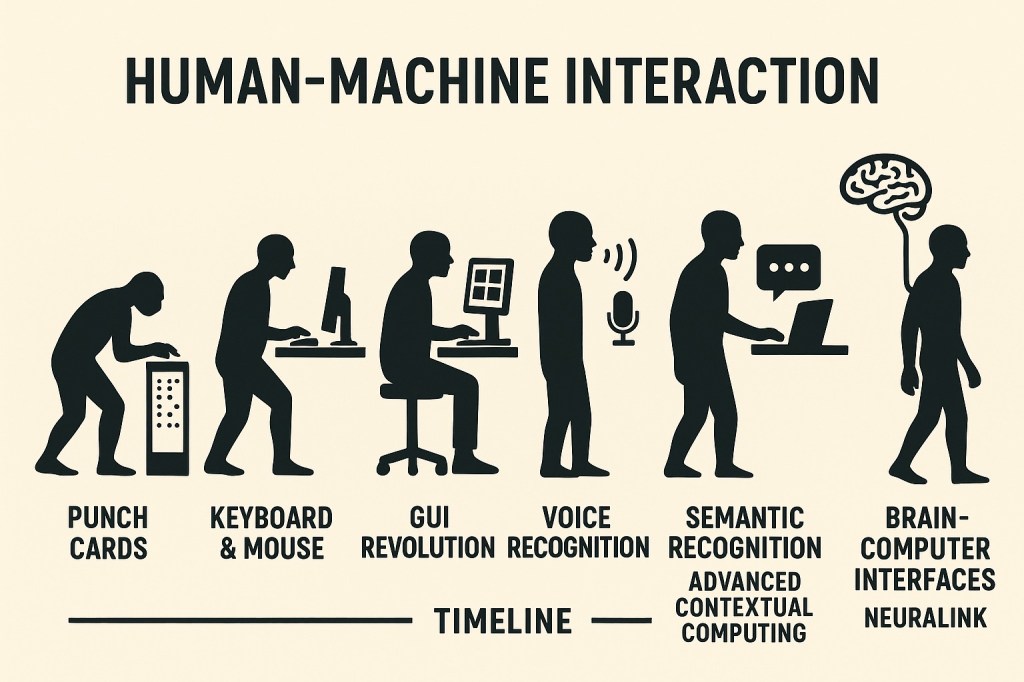
I really like the image that supports this blog, showing the progression of Human-Machine Interaction using the visual analogy of human evolution. This isn’t meant to be an immodest boast. It cannot be. This image isn’t my achievement. That laurel belongs to Generative AI, and it took all of 30 seconds to create it. Today, most creative expressions require just a strong foundational thought and the right prompts – a far cry from three decades ago when MS Paint, which intricately filled in individual pixels, or even as recently as five years ago where talented and trained graphic designers worked with specialist graphics editor software to create images.
My point is that technology has gotten so smart that it takes a few human inputs, stated in natural language, for the machine to understand exactly what you want and deliver an accurate representation of it, whether in words, pictures or even complex software algorithms. The interesting part of this is the inversely proportional relationship between the smartness of a machine and the amount of human effort required to get output from it. Modern aircrafts run on autopilot, whereas it took a human managing a bewilderingly intricate set of wires and levers to fly the original aircrafts like the Kitty Hawk. The modern day rail’s locomotive pilot presses buttons to control trains, whereas James Watt’s steam engine required them to continuously break their backs feeding coal into the engines and work in high temperatures.
I remember once hearing an interesting definition of a “machine” as something that is designed to reduce human effort. The relationship between a human and a machine is therefore one of input provision and resultant action respectively. This is where the inversely proportional relationship between the two (as I have mentioned above) intrigues me. The evolution of the machine, in this particular context, is comparable to how every human being evolves. As babies, we require a lot of input to get even the simplest output, whether in speech or in action. As we grow, our reactions to stimuli start getting increasingly sophisticated and faster and it takes lesser input to result in actions from us. Machines have evolved in a very similar fashion over time.
In computing, we have come a long way from the early days of human input through simple devices such as punch cards and switches or even the keyboard and mouse,to the modern, sophisticated methods such as voice-to-text of today. The finger has replaced the keyboard or mouse in several modern machines such as smartphones. The Graphic User Interface concept has become ultra-smart too and the need for these traditional input systems has reduced dramatically in modern GUIs.
What the mouse did for GUI navigation through Douglas Engelbart’s invention of it in the 1960s, with intuitive interactions such as hypertext linking, document editing and contextual help, conversational systems like Alexa and Google Assistant are doing today for touchscreens and voice interfaces.
Modern human-machine interaction is replete with accessibility, context awareness and personalization. It is this transformation in input systems which has paved the way for semantic recognition and advanced contextual computing. In more recent times, this is where AI has been leveraged to interpret what the user wants – beyond just simple commands. The move into the machine working on the intent of what the human wants is already here, with advanced natural language processing, and multimodal memory retrieval using text, voice, and visual cues. With the help of AI-driven contextual search and memory recall, we are moving towards a precision-first age of user engagement.
If we are already here, what’s next?
Think Black Mirror, but in a more positive way. The near future is all about brain-computer interfaces. Neuralink and similar efforts now represent the frontier of direct neural interaction – where thoughts can become machine commands, and unlock new forms of accessibility and augmentation. There are prototypes that feature high-density brain implants like the N1 sensor that control devices directly from neural signals. Think it, have it. And this is the future of seamless, intuitive and context-rich human and computer interaction.
From humans having to learn the language of the machine, to machines now learning the language of humans, we have made tremendous advancements in technology. And to think that all it takes to generate something is just a thought – no machine language, no codes.
And if the future is already here, what lies beyond?
-
Why Robotics Needs to Be Designed for Uncertainty
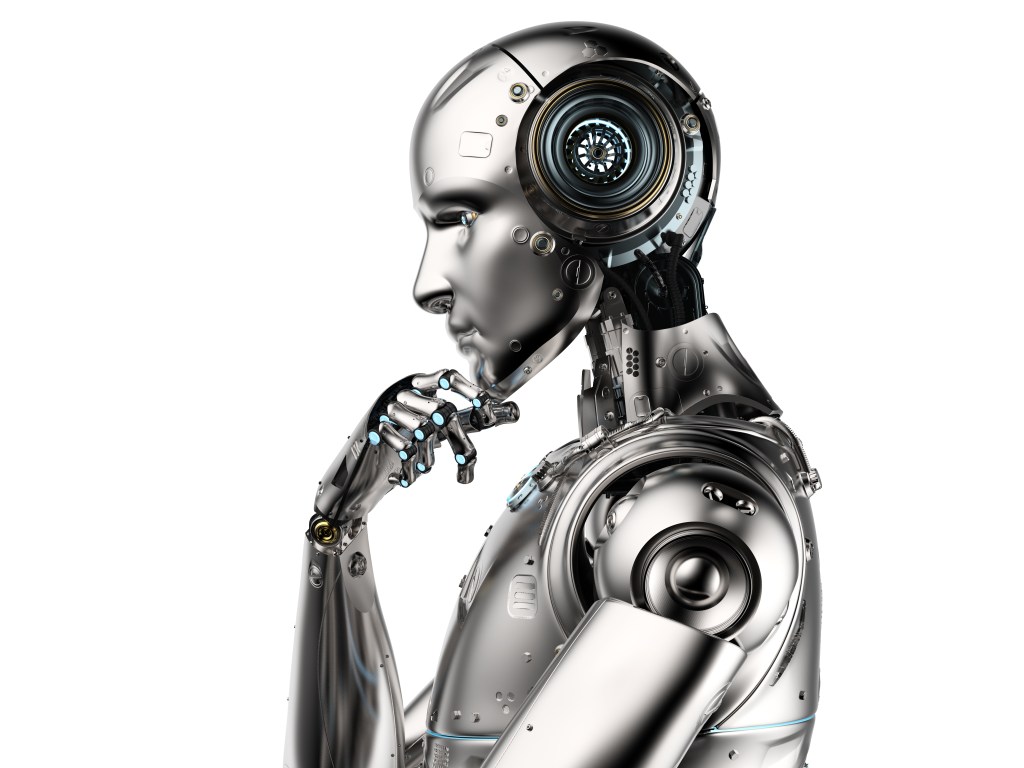
When we mention “robotics” today, let’s not immediately picture those complex images that you’d find on a stock photos website. Instead, I’d like you to take into consideration a device that you’re likely to have at home – the genius that is the little robotic vacuum cleaner. That little disc-shaped wizard glides across your floor on its own, doing its chores without a complaint in the world. It has evolved tremendously from its inception in 1996, and from bumping into obstacles all along its path to learn its route and struggling to climb over mildly uneven surfaces, robot vacuums have come a long way. They now understand maps, obstacles and blocks, and work around them independently without one having to pick them up and place them back like an unstable toddler that’s just learning to walk.
All this is mainly because robots nowadays are equipped with analytical models that need to plan for uncertainty. They have the ability to think of countless scenarios and work out how to overcome them. When it comes to preparing for conceivable scenarios, it’s impossible to be fully prepared. But empowering these robots with an understanding of what is important, and how to prioritize helps them learn and make decisions as they go.
And this is what designing for uncertainty is all about.
At ABB, we have Autonomous Mobile Robots (AMRs) which are designed to move and navigate independently in a given space using sensors and AI. These transport robots move loads autonomously in various industries – from automotive to logistics to consumer goods and other industrial processes. Earlier, they would follow a path they’d been taught to go on, and any reconfiguration of the path meant a reconfiguration of the robot as well. But it’s been learned over the years that change is inevitable, and in today’s tech world, uncertainty is built into the robot, giving it a decision making power.
What is uncertainty? It basically can be anything from an internal or external source that can break the fixed pattern of what the robot has learned. From changes in its usual environment to unplanned events, uncertainty is anything that causes the robot to evaluate factors that have come in its usual set pattern of decision making. It learns, evaluates its solution, and refines its abilities through this trial and error system. Remember our BASIC computer commands of IF, THEN, ELSE? It’s almost the same, but accentuated by the advances in technology like AI and Visual Slam.
Visual SLAM is a navigation technology that combines AI and 3D vision using off-the-shelf cameras. It allows AMRs to make intelligent decisions based on their surroundings, providing higher accuracy and robustness even in challenging environments. It can help differentiate between fixed navigation references and moving objects and people that aren’t permanently a part of the map. This adds a whole new dimension of flexibility to tackle how uncertain situations can be worked with.
This is the era of resilience in tech – where robots aren’t just about precision, but also adaptability. The more human they become, so does their power to make decisions and find a way around a situation that they hadn’t been programmed for, increase. And I’m not just talking about AMRs and robot vacuums, but everything from self-driving cars to educational, service and medical robots. Planning for uncertainty is surely less straightforward, but an essential step to make the robots of the future more robust, efficient and imaginative.
-
Momentum Is a Design Choice
Momentum is a critical, yet often overlooked aspect of program management. In my many years of designing and implementing complex, multi-stakeholder programs, this has been an important learning – that momentum is a major make-or-break factor. This is a result of the human psyche and a very innate bias towards organization and pigeonholing. Why is it that multitasking is something that everyone practices but few are actually good or effective at? It is again a result of this need for organization.
Distraction is a source of chaos. A killer of human focus. Chaos though is also a reality of most projects, unfortunately. Even the best conceptualized projects and programs face the plan-reality dissonance. Not everything goes as per plan – sometimes the factors affecting a program result in the need for minor tweaks and in other cases, major change of direction. However, it is inevitable that most programs roll out with the need for change and adaptation as they progress.
Maintaining momentum is a key success enabler in this context. It is common knowledge that most programs start with an immense amount of enthusiasm and eagerness, which fades over time. This is a psychological occurrence too – what seems novel and exciting at the start, progressively moves to becoming mundane. This impacts program momentum.
A glossary of physics terms will tell you that “momentum” is defined as “the quantity of motion of a moving body, measured as a product of its mass and velocity”. Or “the impetus gained by a moving object”. While we of course extrapolate this definition to the context of project and program management to imply that a project is moving along at a certain pace (predefined or otherwise), I do have an additional definition here. To me, momentum is also about keeping the focus of project teams alive, particularly when it comes to quality and innovation – the softer side of success in program rollouts.
This momentum isn’t accidental. It doesn’t happen on its own. It has to be built through deliberate rhythm, repeatability and realistic systems; and is something the leadership of the program must build into the system of program implementation. Momentum Maintenance should be an important line item as program managers work through designing implementation plans. It’s like choreography – planning it all out such that periods of high activity and low are planned to keep the traction going and introducing enough forums to ensure program teams stay motivated and focused.
Momentum, in that context, is something you build into the system. It looks at rhythm, repeatability, and steady frameworks that carry progress even on difficult days. It will show how designing for momentum means setting up systems that don’t rely on constant motivation but still move things forward. The idea is that the best momentum is engineered, not improvised. This is where the concepts of design thinking, especially the empathy for, and the foundation of human behaviour, are most relevant. Applying a structured process to this softer side of program rollouts is a critical element of program management – one that can make a major difference in achieving the optimal targeted result.
“You do not rise to the level of your goals. You fall to the level of your systems.”
– James Clear
-
The rise of AI agents and their increasing value in a changing enterprise context

That Artificial Intelligence has been a major game changer is a self-evident truth. After all, it has inspired a whole new industrial revolution of its own. The fourth industrial revolution (or Industry 4.0) has been built on the back of cutting-edge technologies, a list in which AI finds a major mention. So, in terms of transformative impact, AI is no less than what the steam engine was for its time or what the rise of computing represented in the 1960s.
We are increasingly seeing diverse applications of AI, and its widespread proliferation in almost every aspect of our lives. To the extent that we don’t even include smartphones without an AI capability of some sort in our purchase consideration set now. Every single major technology corporation is offering embedded AI for various business and personal applications. It is almost ubiquitous as a concept and its real-world application today.
However, to date, AI implementations in the enterprise have been largely limited to micro-impact. These implementations have mainly been in the form of chatbots or personal productivity tools. These are useful but, in my opinion, don’t do justice to the power and potential of this game-changing innovation. AI tools, still in the infancy of their application in organizational contexts, are yet to deliver material business impact at scale. Today, they assist individuals but don’t yet transform how work gets done.
All of this is at the cusp of changing. And driving this change will be the rise of AI agents, digital “colleagues” that can perceive, decide, and act autonomously. Unlike chatbots, agents are goal-driven, collaborative, and capable of executing tasks end-to-end, across systems and workflows. The introduction of AI agents is poised to significantly alter a paradigm that has been in play for over 30 years now: that we have been customizing our enterprise applications to improve efficiency. i.e. do more with fewer people.
With AI agents, this concept of reducing manpower to improve efficiency flies out of the window. To enhance efficiency, we can now have more workers, potentially an unlimited number, except that these will be digital coworkers. As this change comes into play, we will need to redefine our understanding and typical methods to calculate “efficiency”.
Today’s formula for this calculation is: Efficiency = Revenues / Human FTEs.
As we introduce AI agents into the mix, the formula changes to: Efficiency = Revenues / (FTE + aFTE) where aFTE = AI Full-Time Equivalent.
This will not be an easy change. It will have its complexity because the transition will not be just about introducing these agents. It will also be about making enterprise applications agent-friendly. Enterprise applications across practices and functions will need to become reliable and autonomous, beyond just being configurable, as they currently are. And this will be a multifaceted process involving technology migration, change management and widespread user acceptance.
This isn’t going to be an overnight transformation, but it’s coming fast. And companies that learn to deploy and manage AI agents at scale will unlock a new era of productivity.
-
Subscribe
Subscribed
Already have a WordPress.com account? Log in now.
 Marco's thoughts