-
Technology Can Connect Us — If We Use It Right

We’re living in a time when technology has made communication faster, easier, and more accessible than ever before. We can message, call, ping, tag, or sync in seconds. And yet, in most organizations, we still hear the same things: “I didn’t know,” “I missed that update,” or “We’re not aligned.”
In my experience, the issue is rarely the absence of information. It’s that communication is happening—just not landing.
Every generation seems nostalgic for the tool that came before. Email felt too slow, until instant messaging flooded our day. Video calls closed the distance but made it harder to focus. We’ve added formats, but not always clarity.
Over the years, I’ve found that connection doesn’t come from the channel. It comes from how you use it. These are three principles I’ve relied on to keep communication meaningful across teams:
1. Adjust the style
Know who you’re speaking to—and how they process information. If you use the right tool with the wrong tone or structure, your message can feel off, no matter how relevant it is. Great communication starts with knowing your audience.
2. Keep it brief
Remember when Mark Twain said, ““I didn’t have time to write a short letter, so I wrote a long one instead.” That’s because clarity takes effort. When information is dense, fragmented, or over explained, it gets ignored. Focus on what matters most—and say it with intention. Brevity builds trust.
3. Choose the right channel
Not everything needs a meeting. Not everything works in a slide deck. Sometimes an email is better left unsent. Misalignment often isn’t about what was said, but how and where it was delivered. Use the channel that respects the message—and the person receiving it.
These ideas aren’t complicated. But they’ve helped me communicate more clearly—especially across complex teams, fast-moving projects, and digital-first environments.
Technology gives us reach. But connection? That still depends on how well we listen, shape, and deliver what we say.
-
The Rhythm That Keeps Goals In Focus
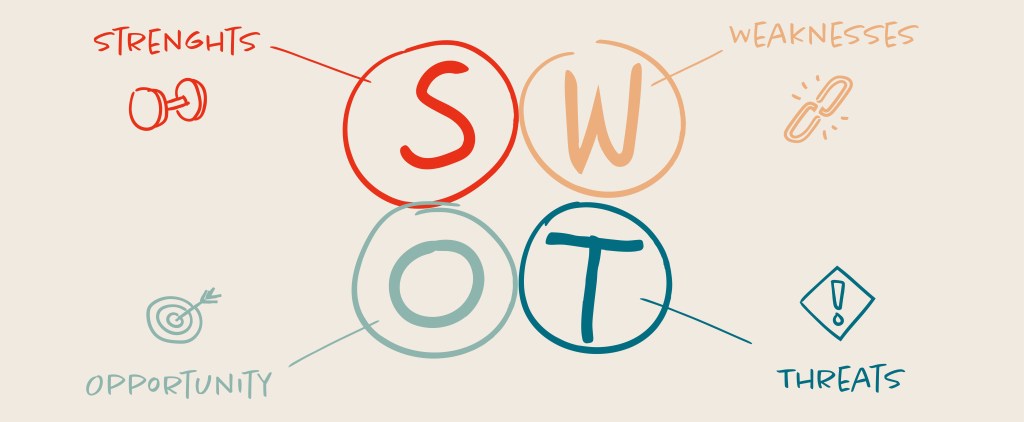
Setting a clear goal for any project is always a great way to start it. The trick, I have learnt through my many years of managing complex projects, is to ensure that the momentum stays high between that first spark, through making real progress, to the final achievement of the goal.
One big risk in every project is that gap between intention and execution. It all starts with excitement: a burst of momentum, maybe even a brand-new app or productivity system. But slowly, things shift. Priorities pile up. Energy dips. Focus begins to blur.
Over the years, I have found a simple method to help build the rhythm as I move from intent to action—not perfectly, but consistently. It’s simple, but it works. And more than that, it’s something I return to whenever the path forward feels cluttered. And this is the concept of SWOT analysis.
It begins, as most things do, with the goal itself. Whether it’s professional or personal, I try to define not just where I want to go, but what success looks like when I get there. The sharper that picture, the more naturally momentum follows. This is the stage then that the SWOT analysis really starts to come in as a gamechanger. What strengths can I lean on? What weaknesses might hold me back? What opportunities could help me move faster? And what threats or risks do I need to account for? It’s a short exercise, but it brings clarity to where I stand and what I’m dealing with.
Off late, I have also started experimenting with generative AI to add more value to SWOT analysis. While the basic principles and foundational ethos remain unchanged, generative AI tools are helping with ideas that are often smart, structured, and surprisingly insightful, once the context is input. I am seeing responses from such tools uncover new angles and sharper sequences; even, identify blind spot I hadn’t considered—and often, that’s all it takes to move forward with more clarity.
After this definition of the context of SWOT, comes the step of visualizing it in an impactful manner. I usually use a simple visual—a Gantt-style layout with rough timelines and key milestones. It helps me see the shape of progress, and it gives me a reference point I can return to each morning to ask: what’s the one thing I need to move today?
And this is where it counts: the follow-through. The daily return to the plan. Not in bursts, not in sprints—but in steady, consistent steps. The real magic often shows up not in the leaps, but in the discipline to keep going—especially on the days when energy is low or the goal feels distant. Those are the days the system earns its keep.
I believe that the simplicity of my method for rhythm building is what makes it powerful. It gives structure without rigidity, and it helps me move even when things around me are shifting. And with GenAI now being part of that rhythm, it has become even easier to start strong—and keep going. Not by outsourcing the hard parts, but by adding a layer of clarity and speed when it’s needed most.
There it is then – my simple formula to go the distance by ensuring that reflection, structure, and momentum all move in the same direction.
-
Majorana 1: A Quantum Leap Rooted in a Century-Old Mystery

This week, Microsoft unveiled something that could change the landscape of computing: Majorana 1, a quantum CPU built to solve one of quantum computing’s biggest challenges—stability.
Unlike traditional quantum chips, Majorana 1 is designed to use Majorana fermions—exotic particles that could make qubits more error-resistant and scalable. It’s a bold step, one that moves quantum technology closer to real-world applications.
But there’s something fascinating about this name—Majorana.
Because long before quantum computing was even a concept, there was a physicist whose ideas laid the foundation for this breakthrough. A physicist who, in 1938, vanished without a trace.
Ettore Majorana: The Scientist Who Disappeared
It’s not often that a scientist becomes a legend. But Ettore Majorana wasn’t just any scientist.
Born in 1906, he was one of the greatest minds of his time. Even Enrico Fermi—his mentor and one of the key figures in nuclear physics—compared him to Newton and Galileo. Majorana had an instinct for physics that seemed almost otherworldly. In 1937, he predicted the existence of particles that are their own antiparticles, now called Majorana fermions. It was a radical idea, one that would take decades to prove. But then, just a year later, Majorana was gone.
In March 1938, a ferry departed from Palermo to Naples. Among the passengers was Ettore Majorana. But when the ship docked, Majorana was nowhere to be found. He had vanished without a trace.
Some say he chose exile. Others believe he was silenced for knowing too much. A few even claim he lived under a new identity, watching the world change from the shadows.
What we do know is that his ideas never disappeared. In fact, almost a century later, Majorana’s theories are shaping the future of modern quantum computing.
From Theory to Reality: The Majorana 1 Quantum Chip
Quantum computers hold enormous potential, but their biggest flaw is instability—qubits are fragile and easily disturbed, making calculations unreliable. Microsoft’s Majorana 1 chip is an attempt to fix this issue at the fundamental level, using Majorana fermions to create topological qubits that are far more stable and resistant to errors.
If successful, this could be the breakthrough that finally makes quantum computing scalable and practical. It’s the kind of shift that could reshape industries, from materials science and cryptography to artificial intelligence.
And at the heart of it all? An idea first written down in 1937.
A Legacy That Refuses to Vanish
Majorana’s ideas were ahead of their time—so much so that only now are we beginning to harness their full potential. His work on exotic particles has gone from theory to reality, shaping the foundation of next-generation computing.
It’s strange to think about. A man who vanished nearly a century ago now has his name etched into one of the most ambitious quantum projects in history.
His story, like his particles, exist in a strange superposition—caught between genius and mystery, waiting for the world to finally catch up.
-
Technologies for a cleaner planet

It is obvious that climate change is a major challenge that humanity is facing today. It isn’t some distant possibility anymore – it is a real, major, imminent global threat. We are already seeing the impact of climate change, from record-breaking wildfires to extreme weather events. And I believe that technological advancements have some answers to help us control this very worrying trend and contribute to a brighter tomorrow for generations to come. With the right innovations, we can create real solutions and innovations to cut emissions, improve efficiency as a human race and build a more sustainable future.
Technology and the power grid
Fossil fuels being used to power up our world is a major contributor to climate change. With more efficient power grids and enabling faster adoption of renewable energy, technology is helping us get smarter about the way we generate and transmit power. As energy systems evolve, technology innovation is helping create more resilient energy networks, with smart grids that allow better integration of renewable sources such as solar and wind.
This makes the power supply more stable and, of course, helps dramatically reduce dependence on fossil fuels. Add to this the impact of AI-driven energy management, with AI taking energy efficiency to a new level. Intelligent systems can monitor and optimize energy use in buildings, cities and industrial sites, minimizing waste and ensuring resources are used where they’re needed most. Energy resilience matters. Microgrids, powered by local renewable energy, ensure communities can stay powered even if the main grid fails. These decentralized energy systems are especially valuable in disaster-prone or remote areas.
Significant strides are being made in clean energy sources, one example being hydrogen as a clean energy carrier. Green hydrogen is emerging as a powerful clean energy source. It can store and transport energy without the emissions of traditional fuels, making it a game-changer for industries like shipping and heavy manufacturing.
Creating more intelligent industries
Industries are the bedrock of human economic activity and, as industrial output increases to meet the demands of a fast-growing world population, factories are contributing to a significant chunk of global emissions. Industrial automation is changing that by ensuring that industries get increasingly ecologically efficient without the need to slow down or pull back.
Smarter, more efficient systems can optimize production lines, reduce waste, and cut down on unnecessary energy use. The impact is massive when scaled across industries. Having said that, certain industries like steel and cement, will always produce emissions. That’s where Carbon Capture and Storage (CCS) comes in—capturing CO2 at the source and storing it underground instead of releasing it into the atmosphere. It’s not a silver bullet, but it’s a crucial tool for high-emission industries. This is all being augmented by some very intelligent systems being developed to help industries contribute to the world’s target on green initiatives. One transformative example here is digital twins, now being used extensively by industries to simulate and optimize processes, reducing inefficiencies and unnecessary emissions before anything is built or changed in the real world.
Altering the way we live, work and play – to create the impact of scale
Almost every human activity is today being influenced by the emergence of tools and technologies that allow each of us to contribute to climate change control. For example, electrification technologies are having a major impact on transportation, another big contributors to greenhouse gas emissions. Electric vehicles (EVs), combined with widespread charging infrastructure, are making the shift away from fossil fuels possible. The transition is picking up pace, and as battery tech improves, EVs will only become more accessible.
EVs are not just limited to personal vehicles but to mass public transport as well. Add to this, innovations that are being explored for aircraft engines to adapt to biofuels and other sustainable fuels and the impact on transportation is a major one. Our buildings are getting smarter and infrastructure far more sustainable. IoT-enabled systems can adjust heating, lighting, and energy use in real time, cutting waste without sacrificing comfort. Meanwhile, sustainable materials in construction are lowering the long-term environmental footprint of new developments.
By doing our bit, we are all contributing to the emergence of the circular economy and resource optimization. Waste is a problem, but technology is turning it into an opportunity. Digital solutions help industries adopt circular economy principles—recycling materials, reusing components, and minimizing unnecessary consumption to reduce environmental impact.
Climate change is a complex issue, but technology is a key part of the solution. From smarter grids to AI-powered efficiency, these innovations aren’t just ideas—they’re already reshaping industries and cutting emissions. The road ahead won’t be easy, but with the right tools, we can build a more sustainable future.
-
Sci-Fi and Reality: Bridging Imagination and Innovation

Eugene Wesley “Gene” Roddenberry was a United States Army Air Corps Veteran who flew 89 combat missions during World War II. Post the war and after retiring from the US Army Air Corps, he became a commercial pilot. Why am I talking about this person? Because it is a little known fact that the original scriptwriter and creator of Star Trek, the cult classic that has a global fan following of staggering proportions (even close to six decades after it first aired) is this war veteran.
There are many prompts and influences which drew me to the world of science from an early age. But I can say unequivocally that a big one in that list is the magical world from the works of authors such as Isaac Asimov or filmmakers such as Gene Roddenberry and George Lucas. It is the vivid imagination that was rooted in scientific thought that inspired me to explore the possibilities that science enables.
I work in the world of robotics today and I am able to draw parallels to the work of Isaac Asimov, once only a literary pursuit through his anthology on robots in my growing years. And I see how strongly the stories they weaved are starting to reflect in reality now. It reminds me of how visionaries like Leonardo Da Vinci were able to see a world that lay well into the future, as evinced by his early schematic designs for a working helicopter.
Somewhere in it all, the fact that people like Isaac Asimov come from a background in sciences (he was a PhD in Chemistry as his academic credentials), implied that while being fiction, the stories that they wrote were rooted in scientific temper. This is perhaps the main reason why you see their fantasies coming to life in later years.
The question then, to paraphrase an old quandary, is whether science fiction imitates reality or reality imitate science fiction. Simply put, I would suggest that well-drafted science fiction, especially when written by people with deep scientific interest and understanding, helps define fantastic outcomes and targets, thereby inspiring innovators in coming years to push boundaries and achieve what was never thought possible.
When Sci-Fi Predictions Come True
There are numerous inventions, including mobile phones, robots and VR that were imagined in science fiction first. Motorola’s Martin Cooper, one of the brains behind the mobile phone and famously remembered for having placed the first public call from a handheld portable device in 1973, credits the two-way wrist radio from Chester Gould’s Dick Tracy as one of the inspirations for this thinking on this project.
Virtual reality, once confined to sci-fi in works like Tron, now shapes industries far beyond gaming—education, therapy, and design are embracing immersive experiences. Asimov’s work on fictional robotics far preceded the first autonomous machines ever developed. Today, immersive technologies like VR also highlight humanity’s responsibility for environmental care, as seen in Wall-E, where robotics is imagined as both a caretaker and a call to action.
Ethics and Society in Sci-Fi
Sci-fi hasn’t just predicted technology—it questions how we use it. Films like Blade Runner (1982) and Terminator explore the ethics of AI, cloning, and autonomy, forcing us to ask: just because we can create intelligent systems, does it mean we should?
Metropolis (1927) adds another layer, depicting the dehumanization and societal divides of an industrialized future—issues that remain relevant today. Orwell’s 1984 and The Day the Earth Stood Still also delve into surveillance and global responsibility, showing how sci-fi doesn’t just challenge us to innovate but also to reflect on the world we’re building. Similarly, even an animated film like Wall-E brings up this ethical dimension, illustrating the consequences of unchecked consumerism and environmental neglect.
Inspiring Futuristic Innovation
The ability of sci-fi to blend ethics, imagination, and innovation has sparked real-world breakthroughs. Star Trek’s vision of a united, technology-driven humanity continues to inspire engineers and scientists, influencing projects like NASA’s Artemis program and SpaceX’s Mars ambitions. These efforts echo the speculative visions of 2001: A Space Odyssey and Metropolis, where humanity dares to push beyond Earth’s boundaries into the vast unknown.
While faster-than-light travel remains out of reach, other concepts, like brain-computer interfaces from Neuromancer, are slowly transitioning from fiction to experimental technology. These advancements demonstrate sci-fi’s power to dream and challenge humanity to create the futures it envisions.
Sci-fi doesn’t just imagine the future—it dares us to dream bigger. Its ability to inspire, provoke reflection, and address societal challenges makes it a powerful force in shaping what’s to come. Tomorrow’s breakthroughs may already be written into today’s sci-fi, waiting to leap into reality.
-
From PCs to AI: Is History Repeating Itself in Tech Evolution?

As we look at how AI is developing, it’s hard not to notice the parallels to past technologies, like the PC and the Internet. These were once revolutionary technologies that sparked concerns and excitement alike. But will AI follow the same path of adoption and societal integration? If history is any guide, we might already know the answer.
The Early Days of PCs
When personal computers first appeared, they weren’t for everyone. People worried that only the wealthy would benefit, leaving others behind. The fear was that this new tech would widen the gap between those who had access and those who didn’t. But, over time, PCs became more affordable, and access spread, especially in schools, closing much of that gap.The Internet’s Journey
The story repeated itself when the Internet became mainstream. Initially, only a handful of developed countries had reliable access, raising concerns about global inequality. But with time, the Internet expanded globally, and initiatives like public Wi-Fi and cheaper devices helped connect more people across the globe.AI’s Present Concerns
Now, with AI, we’re seeing similar fears: Will AI take jobs? Will it amplify bias and inequality? These questions echo the early concerns around PCs and the Internet. But just as we adapted to those technologies, there’s a growing sense that we’ll find ways to integrate AI responsibly too.Self-Regulation of AI
But here’s the interesting part—just like with PCs and the Internet, we’re seeing the industry step up. Competition, industry standards, and societal pressures are pushing AI towards responsible use without the need for heavy regulation. It’s a bit like self-driving cars: innovation is moving faster than laws can keep up, but frameworks are already emerging to ensure it’s done right.Ethical AI Development
We’re also seeing ethical frameworks and standards take shape around AI. Just like we developed rules for privacy and data protection online, there’s a growing movement to ensure AI is built and used responsibly. This will be key in making sure it benefits everyone, not just a select few.
Every new technology brings its own set of challenges, but if history is anything to go by, society adapts. AI will likely follow the same path as PCs and the Internet—becoming a tool that, with time and care, works for everyone. We’ve done it before, and we’ll do it again. -
Balancing Innovation and Sustainability: The Future of Robotics

The decisions we make now can shape the future. Especially in robotics – whether it relates to energy use, materials, or design, every choice has real environmental consequences. Balancing innovation with sustainability isn’t always easy, but when they intersect, the opportunities are exciting. I believe they’re two sides of the same coin, pushing robotics forward in ways that benefit both industry and the planet.
Energy-Efficient Robotics Designs
In robotics, one of the most exciting aspects is how much we can reduce energy consumption in industrial processes. However, creating prototypes that meet these efficiency goals while satisfying all stakeholders is no small feat. Finding the perfect balance between sustainability and practicality is always a challenge. But it is one that yields long-term environmental benefits.
Robotics in Sustainable Manufacturing
Precision is key, and robots have it in spades. In manufacturing, robots are minimizing waste and improving resource utilization, aligning with the growing consumer demand for eco-friendly products. By using less material and enhancing efficiency, the modern robotics practice is reshaping production processes in a way that benefits both businesses and the planet.
Extending Product Lifecycles
A lot of what drives sustainability in robotics is thinking about longevity. I’m particularly fascinated by modular robotic systems that extend product lifecycles. It’s not just about efficiency in the short term; it’s about reducing e-waste and building products that are easier to repair, upgrade, or even recycle.
Renewable Energy-Powered Robots
Something else that’s exciting is seeing robots powered by renewable energy sources, like solar-powered agricultural machines. This shift not only reduces reliance on fossil fuels but also opens up a future where the tools we create are in harmony with the environment. The potential here is massive, and it’s something we’re just starting to scratch the surface of.
Challenges in Sustainable Robotics
Of course, there are challenges. Balancing sustainability with stakeholder demands, ensuring costs don’t skyrocket -these are constant considerations. However, with increasing consumer awareness and demand, addressing these issues head-on can lead to innovative solutions that benefit both the environment and the bottom line.
As robotics continues to evolve, its role in promoting sustainability is becoming clearer. From energy-efficient designs to renewable-powered machines, robotics is transforming industries and opening up new possibilities for a greener future. We’re just at the start of discovering what’s possible, but the future looks promising.
-
A Glimpse into the Future: The Odyssey of Autonomous Vehicles

It is amazing how autonomous vehicles have transformed from simple beginnings to complex systems that we witness today. The story begins in the 1920s and 1930s through basic tests with radio-controlled vehicles. Though primitive, these early attempts laid the groundwork for the monumental strides we are seeing today.
A notable milestone was the DARPA Grand Challenge of the early 2000 which marked a turning point that expanded the possibilities of what could be achieved. Then came Google’s self-driving car project that popularized autonomous vehicles. With progress in AI, machine learning, and sensor technologies; these vehicles not only remain dreams but are becoming practical initiatives.
One thing I find most fascinating is their potential for mobility and accessibility enhancement. The possibility of drastically reducing traffic accidents arising from human error is a significant gain for road safety. These cars also present novel transportation options for senior citizens and handicapped people thus assisting them to live independently and inclusively.
The economic and employment impacts of autonomous vehicles showcase the potential for new opportunities in tech, maintenance, urban planning, AI, and cybersecurity. The process might be challenging; though the long-term benefits may be significant.
From an environmental perspective, autonomous vehicles offer a promising avenue to reducing emissions through optimizing driving patterns. This sustainable transport system could lead to less traffic congestion as well as an eco-friendly transportation system. Moreover, these cars assist in sustainable town planning by decreasing parking needs and increasing green spaces.
Despite this, several obstacles continue to bar the acceptance of self-governing vehicles on a large scale. Ethical issues including decision-making in cases where accidents cannot be avoided have huge implications. It is also essential to develop strong regulatory systems for safety, privacy, and conformity across jurisdictions.
To sum up, autonomous cars are much more than technological breakthroughs; instead, they mark a paradigmatic departure in transportation philosophies. The possibilities that they present about security, accessibility, and sustainability are overwhelming; but navigating the ethical, economic, and regulatory challenges will be key to realizing this future.
-
The power that is quantum computing and its potential to create real, transformative impact

While binary computing has come a long way from its initial days and when the transistor was first used in computing, it is now reaching a stage where its capacity will start to become insufficient.
The power of classic computing is based on a straightforward concept: the more transistors there are on a chip, the more powerful the computer will be. And, therefore, to increase computing power, we should be able to squeeze the size of the transistor. We have done this successfully over the years using Moore’s Law. Case in point: the PC of the 1970 had about 300 transistors. The iPhone you carry in your pocket today has 19 billion!
However, the limit to which we can reduce of the transistor is now starting to reach its lower threshold. Which implies that we are close to reaching the peak of enhancing computing power through reduction of transistor size.
This is where the power of quantum computing will act as a powerful next step to continue the innovation in automation and data processing. To understand what quantum computing is, it is important to get a feel for its underlying concept – quantum superposition and its extension into quantum mechanics.
You may have heard of a thought experiment by Erwin Schrödinger, where he put forth a hypothesis – a paradox that a cat may be considered both alive and dead at the same time. Imagine this cat is put in a box with a poison that can be activated under certain conditions. When the box is closed (and you cannot see what’s happening inside), there is a 50% probability that the cat is alive and 50% that it is dead.
This hypothetical phenomenon, commonly known as “Schrödinger’s Cat”, is one of the most fascinating parables to describe quantum superposition. Conversely, once the box is opened and we witness whether the cat is dead or alive – that is a binary (yes or no) position, which leads to the collapse of the quantum superposition.
I have had a deep fascination with quantum mechanics from my very early days. This is mainly thanks to the fact that I studied it at university and found it to be a powerful theory with many applications. The fascination has stayed with me over the years. Today, as quantum computing starts to make strides towards becoming a realizable concept, I still believe that it has the potential to make a remarkable impact on diverse aspects of the way the world lives and does business.
The basic principles of quantum computing
There are a set of terms which describe the various components of quantum computing. While these sound technical, I have done my best to explain what they mean. The first is Qubits (or quantum bits), which act as basic units of information. They use principles of quantum superposition to result in the linear combination of two states. They are interdependent and go through “entanglement” when what happens to one Qubit results in an impact on another. Then come Quantum Gates, which form reversible circuits to help perform basic operations.
Combined with Quantum Algorithms to add structure / process to run an operation, Quantum Decoherence to support environmental interaction and error correction, and Quantum Supremacy which showcases its speed advantage, quantum computing becomes a realizable and implementable concept.
Using the power of quantum computing
Given the exponentially increased speed of computing it enables, the concept can have a transformative impact in several use cases that I can think of, some examples of which include:
- Cryptography and its applications in cyber security: quantum key distribution can make messages super-secure and almost impossible to hack and is a powerful alternative to classical cryptography
- Optimization by enabling near-accurate predictive models – for use in industrial applications such as supply chain or social infrastructure ones such as traffic management by redistributing cars in dense road networks, assisting in intelligent routing, etc.
- Molecular simulation and protein folding helping drive smarter and faster drug discovery
- Use of evolved risk analysis and fraud detection to make financial models stronger and banking operations more secure
- Impact on material science by driving the discovery and design of new materials, including high-temperature semiconductors
The world is already at a stage where Artificial Intelligence is starting to make great strides in being practicably applicable in real-world scenarios. By enabling enhanced capabilities for machine learning and driving complex data analysis, quantum computing is bound to have a major impact on its efficacy and application in the fourth industrial revolution and beyond.
Are we there yet?
Admittedly, quantum computing is still in its nascent stages. It cannot act as an alternative to classical computing at its current stage of development and is being used to solve specific problems in a small scale today. We have several challenges to address before this starts to become a reality.
The primary one is keeping qubits in superposition. This needs the particles to stay near absolute zero (−273.15 °C). Moreover, quantum superposition is a very unstable state with the need of complex correction processes. In its current stage of development, it is still open to security vulnerabilities, including RSA (asymmetric) encryption threats and the resultant need for post-quantum cryptography. In its untested stages, it could therefore lead to potential breaches of sensitive data and threats related to infrastructure security.
Beyond the conceptual threats is the socioeconomic and geopolitical impact, where development of a powerful tool such as quantum computing could drive a quantum arms race and lead to significant increase in espionage and surveillance.
What lies ahead…
But these risks and challenges cannot impede the march of quantum computing. And, much like any other transformative concept, the world will find a safe way to benefit from its power. Every time a new wave in technology is about to begin, it brings along a wave of fascination and suspicion. AI and IoT are the most recent examples of how such fascination and suspicion has been overcome and how they have become part of our everyday lives today.
A powerful concept such as quantum computing will, when it materializes, disrupt everything that we are accustomed to in terms of ways of working and how we think.
-
Striking the balance in a new, digital-first world

The role of the CIO has changed dramatically over the past few years – especially the last three to four. And the primary reason for this is the massive increase in the data we produce as individuals and, therefore, collectively as enterprises. When the amount of information increases in this dramatic manner, it stands to reason that the Chief Information Officer has a lot more to do in terms of controlling it and making it work for the organization.
These have been the two areas of my focus over these past few years. Actually, this control of information flow in the enterprise and harnessing it to create business value has always been my role. It has just become tremendously enhanced and exciting in these recent times. With the excitement, however, comes the stress of managing such volumes of valuable information and addressing the various strategic, tactical challenges that modern data ecosystems face, including (and at the top of the list) aspects such as governance and cyber security.
My typical day as a manager of information system frameworks is reflective of this major change in information systems themselves. I thought it would be of value, therefore, to outline what my typical day (and the day of any IS leader) looks like.
Well begun actually is half done – in more ways than one!
While I think it is true of most modern professions, the task of leading the management of complex information systems today is a highly stressful ask – one that takes a high degree of multi-tasking and concurrent focus on several strategic priorities. The golden hour from 6.30 onwards help me prepare for the excitement of the day ahead. I am a firm believer in the “healthy mind in healthy body” saying and my passion for cycling supports this intent. Every morning, I make it a point to cycle – to clear my mind and get alertness levels up. Cycling also gives me the focused time to get my thoughts sorted – I have realized over time that some of the best ideas come to me as I am out cycling.
The day is all about balance
As I mentioned, there are myriad priorities that the modern-day CIO has to account for. We live in a world surrounded by data but I refer to this as data madness. My actions and interactions through my day cover some of the most important aspects related to managing this data madness and introducing method into it.
Some of the most critical topics that my peers, business colleagues, team and I cover everyday centre around:
- Data aggregation and analytics to create insights to support business decisions and direction
- Cost and spend management to get targeted returns in an optimized manner
- Managing risks related to information systems and business continuity
- Always staying prepared and protected against cyberattacks
- Focusing on the creative ideation to drive strategic initiatives, examples of which include ERP modernization, B2B e-commerce, AI applications, etc.
As is visible from the list, the day in the life of a CIO is filled with the challenge of adapting to an exciting, new, digital-first world while ensuring that strong planning, program management and cost management help make it reality. Of course, there are several other aspects that are inherent in any leadership position – activities such as talent management, vendor ecosystem alignment and ensuring that IS teams rapidly adapt to organisational changes form part of the daily routine as well.
In all of this, the importance of “balance” cannot be understated. I strongly recommend that breaks during the day (a leisurely lunch alone or brainstorming with colleagues, a 15-minute walk every few hours to give the body the rejuvenation it needs, etc.) should form part of all our schedules.
Focusing on who we do it all for
At the end of the day, we do what we do to create a better future for our family and give ourselves an enriching existence. I make it a point therefore to leave office by 7.00 / 7.30 PM to give myself enough time with family and friends. Those who know me, know that I am passionate about my hobbies – pens, watches, video games and reading. These hobbies help me further strike the balance between the pressures of our professional existence and a fulfilling life.

Do what matters and do it well
Describing my day is my way of sharing what my life experiences have moulded me into. I truly believe that habits get formed young – of course, there is no age where one cannot reinvent themselves but the discipline one sets at a young age goes a long way in creating lasting personalities. The main advice I would have for young people, therefore, gets captured in that word I used here earlier – balance. Whether between physical wellbeing and mental, work priorities and family, this concept of balance is what will help achieve all that one aspires for. And more.
-
Subscribe
Subscribed
Already have a WordPress.com account? Log in now.
 Marco's thoughts