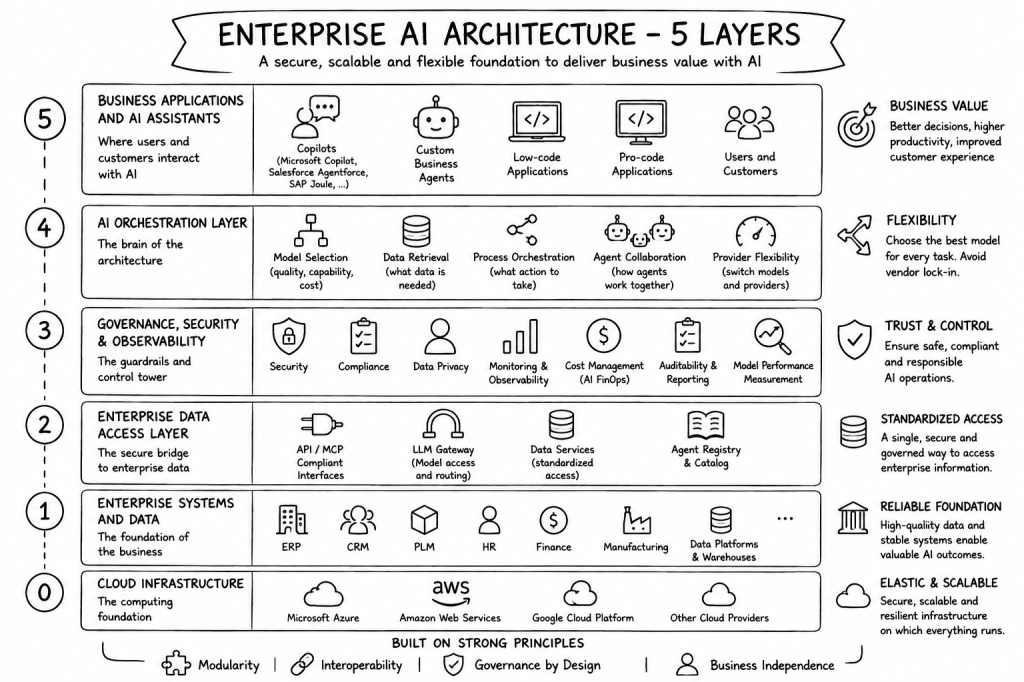
Artificial Intelligence is rapidly becoming part of every business discussion. Yet many executive conversations focus on AI tools, vendors, or use cases, while overlooking a more fundamental question:
What does an enterprise-grade AI architecture actually look like?
Just as ERP systems, cloud computing, and cybersecurity required specific architectural foundations, AI also requires a structured architecture to be scalable, secure, and cost-effective.
Four Architectural Principles
Regardless of technology choices, successful AI architectures follow four principles.
- Modularity: Components should be replaceable without redesigning the entire ecosystem.
- Interoperability: Different platforms, models, and agents must work together.
- Governance by Design: Security, compliance, and observability should be embedded from the beginning.
- Business Independence: Business processes should never depend on a specific AI provider.
Building Blcks of an AI Strategy
This article introduces the key building blocks everyone should understand when discussing AI strategy.
Layer 0 – Cloud Infrastructure
Every AI solution ultimately runs on computing infrastructure, whether in public cloud, private cloud, on-premise environments, or at the edge. Whether provided by Microsoft Azure, Amazon Web Services, Google Cloud Platform, or other providers, this layer delivers the computational power required to train and execute AI models.
The key consideration is not the technology itself but understanding that AI consumes significant computing resources and therefore has a direct economic impact.
Layer 1 – Enterprise Systems and Data
This layer contains the systems that run the company: ERP, CRM, PLM, HR systems, Manufacturing systems, Data platforms.
These systems contain the knowledge of the enterprise. A simple rule applies:
Without access to enterprise data, AI remains an intelligent assistant. With access to enterprise data, AI becomes a business capability.
Layer 2 – Enterprise Data Access Layer
One of the biggest mistakes organizations can make is connecting every AI solution directly to every application. Instead, leading companies introduce an abstraction layer between enterprise data and AI platforms.
This layer provides secure and governed access through APIs, emerging standards such as Model Context Protocol (MCP), and others standardized interfaces. Think of it as the “universal translator” between business systems and AI.
The strategic benefit is flexibility. Business systems remain stable while AI technologies continue to evolve.
Layer 3 – Governance, Security and Observability
This is often the least visible but most important layer. It includes:
- Security
- Compliance
- Data privacy
- Monitoring
- Auditability
- Cost management
- Performance measurement
If Layer 2 answers the question: “Can AI access our data?“
Layer 3 answers: “Should it?“
This layer establishes trust and control. Without it, AI adoption will eventually collide with regulatory, legal, or operational concerns.
Layer 4 – AI Orchestration
This is the brain of the architecture. Its role is to decide:
- Which AI model should be used
- Which enterprise data should be retrieved
- Which business process should be triggered
- How multiple AI agents collaborate
The orchestration layer coordinates models, agents, tools, and workflows to execute business tasks based on capability, performance, and cost. This prevents dependence on a single provider and allows continuous optimization.
Layer 5 – Business Applications and AI Assistants
This is the layer employees and customers actually see. Examples include:
- Microsoft Copilot
- Salesforce Agentforce
- SAP Joule
- Industry-specific AI assistants
- Custom-built AI agents
A common misconception is that these tools are the AI strategy. They are not. They are simply the user interface of a much broader architecture. The true enterprise value resides in the layers below.
Beyond Technology
Even the best architecture will fail without four complementary elements:
- Process reinvention
- Workforce upskilling
- Strong operating models
- Strategic ecosystem partnerships
Technology creates potential. People, processes, and governance convert that potential into business value.
A Final Thought
- Twenty years ago, every executive learned the basics of ERP.
- Ten years ago, every executive learned the basics of cloud computing.
- Today, understanding AI architecture is becoming equally important.
Not because CEOs and CFOs need to become technologists, but because the quality of their strategic decisions will increasingly depend on understanding the foundations on which enterprise AI is built.
 Marco's thoughts