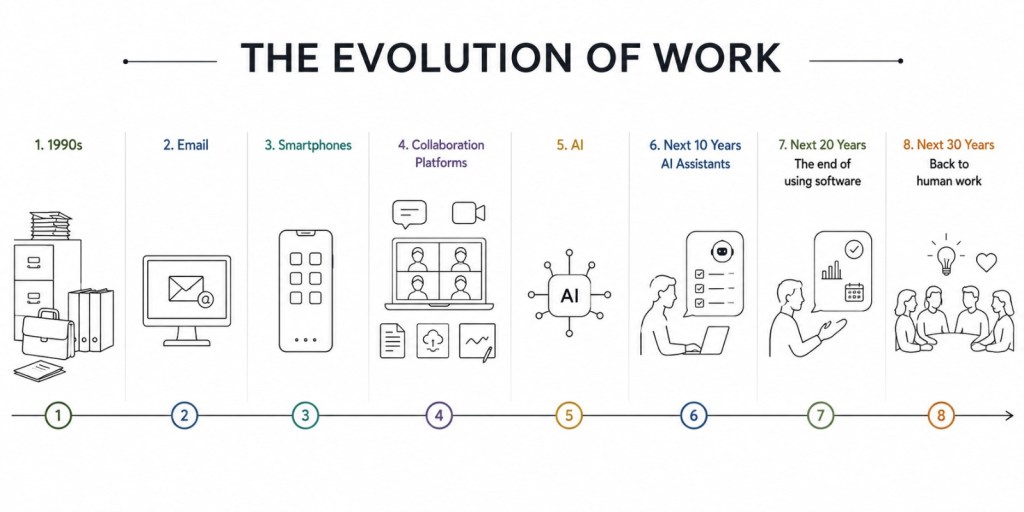
Thirty years ago, when I just started working, the office sounded very different. Printers were loud enough to qualify as industrial machinery. Modems sang strange robotic songs while we waited for them to connect to the internet. And if someone told you that they’d sent you a message, it most probably meant that it was a fax, a voice mail or a handwritten note on your desk. These were before the days of e-mail. Well, technically, it still existed, but to most people, it was closer to science fiction than productivity. Our “cloud” was a cabinet full of folders. And our version of the search option was to physically look for whatever you wanted. Sometimes, you even had to talk to people face-to-face! They were terrifying times indeed.
The era of physical work
In the 1990s, work had weight. Documents were printed. Presentations were carried in bags. Meetings required actual travel. And losing a notebook could create more panic than losing a smartphone today. It was a time when knowledge moved slowly and decisions took longer. But strangely, we were often less stressed. You could leave the office and become unreachable. Imagine that happening today! Disappearing for even two hours creates the same organizational reaction as a cyberattack!
Humanity’s first productivity trap
The arrival of the e-mail felt revolutionary. Suddenly communication became instant. No more waiting days for replies. No more fax paper jams. We lived under the delusion that technology would give us more free time.
But let’s not forget that humans also invented –
- Reply All
- Endless CC lists
- And the beautiful sentence: “Just checking if you saw my previous e-mail.”
E-mail increased productivity enormously, while simultaneously creating an entirely new category of work- that of managing e-mail itself. It is, some might say, an innovation worthy of admiration.
The escape of the office
Then, smartphones arrived. For the first time in history, work became portable. At the beginning, it felt empowering to answer e-mails from anywhere, access documents remotely and even join calls when travelling! But it wasn’t long until we realized something important.
We realized the office was no longer a place.
The office was following us. Vacations became remote working with a better view.
To infinity and beyond!
Collaboration was the next big thing. It was the coming of multiple chat platforms, video calls, shared documents, digital whiteboards, project management tools, and collaboration ecosystems.
The promise was simple. To work together more efficiently.
But the result? Meetings to prepare for other meetings. Chats discussing previous chats. And collaborative documents where nobody knows who changed what.
At some point, we have collectively accepted that spending eight hours per day discussing work has somehow become equivalent to doing work. A fascinating sociological evolution indeed!
And now… AI
We are now in the midst of another transformation. The magic two-letter word.
AI is not just another software tool. It’s the first technology that actively collaborates with us intellectually. It writes, summarizes, analyzes, generates code, creates presentations, translates and even challenges ideas.
For the first time, many people are not using software anymore. They are interacting with something that looks surprisingly close to a digital colleague.
And this changes everything.
The next 10 years: AI assistants everywhere
In 10 years, I suspect most professionals will have a personal AI assistant working continuously beside them. And no, I don’t mean a chatbot. We are likely to have a real operational companion that prepares meetings, negotiates schedules, helps draft decisions, monitors projects and anticipates risks. It might even politely tell us when our ideas are terrible!
The funny thing?
Young employees entering the workforce will probably look at us the same way we looked at people using fax machines.
“Wait… you manually created PowerPoint slides?”
Yes. And we survived.
The next 20 years: The end of using software
Twenty years from now, I believe many traditional applications will disappear. Instead of learning systems, menus, and interfaces, people will simply describe outcomes.
Imagine saying- “Prepare the quarterly business review, analyze the market, identify risks, create the presentation, and schedule a rehearsal with the leadership team.”
And the digital ecosystem simply executes. The concept of ‘software training’ may sound as old-fashioned as typing classes today.
The next 30 years: When work will become more human again
My prediction for the future is all about coming back, full circle. This may sound paradoxical, but I believe AI will eventually make work more human. Why so, you may ask. Simply because once machines handle repetitive cognitive tasks, uniquely human capabilities become more valuable. Just like the people on the internet are now complaining about “AI slop” for the overuse of what’s not ‘real’, we are probably going to place a lot more value on qualities like judgement, trust, creativity, leadership, empathy, ethics and vision. The future CIO, CEO, engineer, or entrepreneur may spend less time producing information and more time interpreting meaning.
Ironically, after decades of technology pushing us toward screens, AI may bring us back towards what humans do best- thinking, imagining and connecting with each other.
But one thing never changed…
Even after 30 years of technological revolutions, one thing remained surprisingly constant. People still complain about too many meetings.
There are some things even AI will never fix. Probably.

