Setting a clear goal for any project is always a great way to start it. The trick, I have learnt through my many years of managing complex projects, is to ensure that the momentum stays high between that first spark, through making real progress, to the final achievement of the goal.
One big risk in every project is that gap between intention and execution. It all starts with excitement: a burst of momentum, maybe even a brand-new app or productivity system. But slowly, things shift. Priorities pile up. Energy dips. Focus begins to blur.
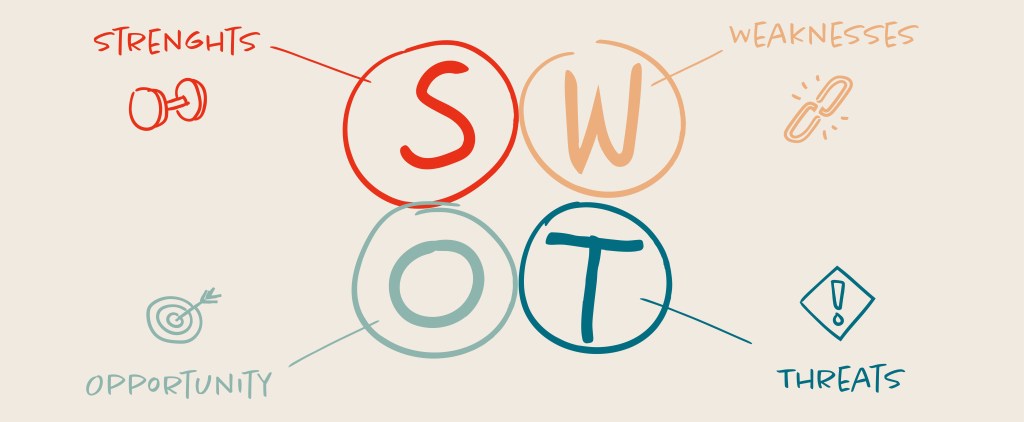
Over the years, I have found a simple method to help build the rhythm as I move from intent to action—not perfectly, but consistently. It’s simple, but it works. And more than that, it’s something I return to whenever the path forward feels cluttered. And this is the concept of SWOT analysis.
It begins, as most things do, with the goal itself. Whether it’s professional or personal, I try to define not just where I want to go, but what success looks like when I get there. The sharper that picture, the more naturally momentum follows. This is the stage then that the SWOT analysis really starts to come in as a gamechanger. What strengths can I lean on? What weaknesses might hold me back? What opportunities could help me move faster? And what threats or risks do I need to account for? It’s a short exercise, but it brings clarity to where I stand and what I’m dealing with.
Off late, I have also started experimenting with generative AI to add more value to SWOT analysis. While the basic principles and foundational ethos remain unchanged, generative AI tools are helping with ideas that are often smart, structured, and surprisingly insightful, once the context is input. I am seeing responses from such tools uncover new angles and sharper sequences; even, identify blind spot I hadn’t considered—and often, that’s all it takes to move forward with more clarity.
After this definition of the context of SWOT, comes the step of visualizing it in an impactful manner. I usually use a simple visual—a Gantt-style layout with rough timelines and key milestones. It helps me see the shape of progress, and it gives me a reference point I can return to each morning to ask: what’s the one thing I need to move today?
And this is where it counts: the follow-through. The daily return to the plan. Not in bursts, not in sprints—but in steady, consistent steps. The real magic often shows up not in the leaps, but in the discipline to keep going—especially on the days when energy is low or the goal feels distant. Those are the days the system earns its keep.
I believe that the simplicity of my method for rhythm building is what makes it powerful. It gives structure without rigidity, and it helps me move even when things around me are shifting. And with GenAI now being part of that rhythm, it has become even easier to start strong—and keep going. Not by outsourcing the hard parts, but by adding a layer of clarity and speed when it’s needed most.
There it is then – my simple formula to go the distance by ensuring that reflection, structure, and momentum all move in the same direction.
 Marco's thoughts